Workplace Investigations in South Africa: CCMA, Fairness and the Paper Trail
In South Africa, a workplace investigation that ignores the fairness requirements of the Labour Relations Act doesn't just risk getting the wrong answer, it risks turning a legitimate dismissal into an unfair-dismissal award at the CCMA. Employers lose these cases constantly, and usually not because the employee was innocent. They lose on fairness and on the paper trail. This guide sets out, in plain English, what a South African workplace investigation has to get right.
A note up front: this is general information, not legal advice. The rules change, and specific matters need a labour lawyer. Always check the current Labour Relations Act, the Code of Good Practice: Dismissal, and current CCMA guidance.
The two kinds of fairness
South African dismissal law turns on two questions, and you have to satisfy both. A dismissal can be substantively perfect and still be ruled unfair because the process was wrong, and vice versa.
Substantive fairness asks: was there a fair reason? Did the misconduct actually happen, was it serious enough to justify the sanction, and was the rule a valid, known one that's consistently applied? Your investigation is what establishes this, on the balance of probabilities, the civil standard.
Procedural fairness asks: was the process fair? Was the employee told the charge, given a chance to respond, allowed representation, and dealt with by an impartial process? Your investigation and the disciplinary process together have to demonstrate this.
Both are tested if the matter reaches the CCMA. Get the evidence right but the process wrong, and you can still lose.
What the balance of probabilities means here
Workplace misconduct is decided on the balance of probabilities, more likely than not, not the criminal "beyond reasonable doubt." You don't need certainty; you need a reasoned conclusion, founded on evidence, that the conduct probably occurred. But "probably" still has to rest on something real. A conclusion built on assumption or reputation fails even this lower standard, and a commissioner will say so.
The process the CCMA expects
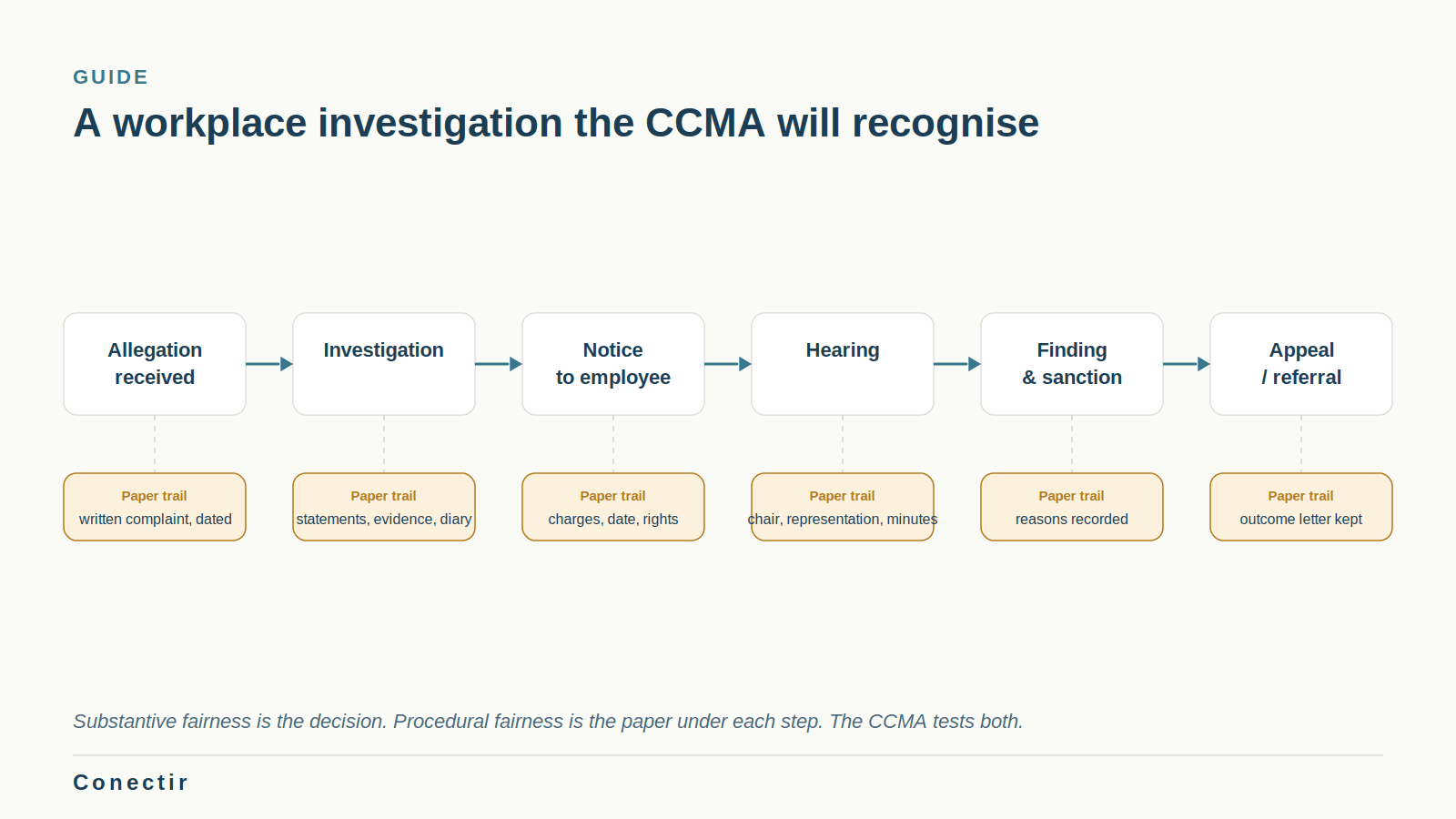
If a dismissal is challenged, the CCMA will look for a recognisable fair process behind it. In broad terms that means:
A proper investigation establishing the facts before any charge is laid.
A clear, specific charge put to the employee, the actual alleged conduct, with dates and detail, not a vague accusation.
A hearing at which the employee knows the case against them, sees the evidence, and can state their side, call witnesses and challenge the employer's evidence.
The right to representation, typically by a fellow employee or a shop steward.
An impartial chairperson deciding the outcome, ideally not the investigator or the complainant.
A consistent, proportionate sanction, like cases treated alike, and dismissal reserved for conduct that genuinely warrants it or for repeat offences after warnings.
The investigation is the foundation of all of this. A weak or unfair investigation contaminates everything that follows.
Where South African employers most often go wrong
Rushing to dismissal without a real investigation. Acting on suspicion or a complaint without establishing the facts first. The CCMA sees straight through it.
Vague charges. "Misconduct" or "dishonesty" instead of "on 14 May you removed stock X without authority." The employee can't answer a charge they can't pin down, and that's a procedural failure.
The investigator wearing every hat. The same manager who complained, investigated, chaired the hearing and decided the sanction. Even with good evidence, this collapses impartiality.
Not putting the evidence to the employee. Reaching a conclusion on evidence the employee never had the chance to challenge, one of the most common reasons awards go against employers.
Inconsistency. Dismissing one employee for conduct others were merely warned for. Consistency is a fairness requirement in its own right.
Overstating the finding. Recording a criminal-style "guilty of theft" conclusion rather than "on the balance of probabilities, the employee removed the stock without authority."
No paper trail. Which brings us to the thing that decides most of these cases.
The paper trail decides it
At the CCMA, the employer generally bears the onus of proving the dismissal was fair, both substantively and procedurally. That is proven with documents, not recollection. The investigation report, the statements, the evidence gathered and its handling, the charge sheet, the notice of hearing, the hearing record, the outcome and its reasons: this paper trail is your case. "We investigated properly and it was fair" carries no weight without the record to back it. Build the trail as you go, contemporaneously, because reconstructing it after a referral looks exactly like what it is.
Consider the employee's side, on paper
The strongest protection against an adverse award is showing you genuinely weighed the employee's version and the innocent explanations, and still reached your conclusion on the evidence. A report that only records the incriminating material reads as a foregone conclusion. One that sets out the employee's account, addresses it, and explains why the evidence still points where it does reads as fair, and fairness is precisely what the CCMA is testing.
Doing this fairly and keeping the record
Running a South African workplace investigation that satisfies both substantive and procedural fairness, weighs both sides, and leaves a clean contemporaneous trail is demanding, especially for line managers who don't do it often. Conectir's Council feature reviews a case from several independent expert angles, including a due-process and a labour perspective, and pre-fills the relevant jurisdiction, surfacing the weaknesses, gaps and alternative explanations before the matter reaches a commissioner. The reporting and audit tools keep the contemporaneous paper trail as you work. It pressure-tests fairness and preserves the record; it never returns a verdict of guilt. If you handle CCMA-facing matters, see how the Council reviews a case.
Related guides
See how Conectir’s Case Council handles this on a real case — leads to verify, never a verdict.
Frequently asked questions
What standard of proof applies to workplace misconduct in South Africa?
The balance of probabilities, whether the misconduct is more likely than not to have occurred, not the criminal "beyond reasonable doubt." The conclusion must still be founded on real evidence.
What's the difference between substantive and procedural fairness?
Substantive fairness is about whether there was a fair reason (the misconduct happened and warranted the sanction). Procedural fairness is about whether the process was fair (proper charge, chance to respond, representation, impartial decision). A South African dismissal must satisfy both.
Why do employers lose unfair-dismissal cases at the CCMA?
Most often on procedure and paper trail rather than the facts, vague charges, not putting evidence to the employee, the investigator also deciding the outcome, inconsistency, or no documentary record to prove the process was fair.
Who bears the onus at the CCMA?
The employer generally must prove the dismissal was both substantively and procedurally fair, and that is proven with documents, the investigation report, statements, charge sheet, hearing record and reasons, not with recollection.
Is this legal advice?
No. This is general information. The Labour Relations Act, the Code of Good Practice and CCMA guidance govern the detail and can change, so verify the current rules and take legal advice on any specific matter.