Workplace Investigations: Balance of Probabilities, Procedural Fairness, and Where They Go Wrong
A workplace investigation is not a criminal trial, and treating it like one is a mistake. But it is not a rubber stamp either, and treating it like that is a bigger mistake, the kind that gets a dismissal overturned and turns a misconduct case into an unfair-dismissal claim. This guide sets out the two things a workplace investigation has to get right: the standard of proof, and procedural fairness. And it covers where investigations most often go wrong.
The standard is the balance of probabilities
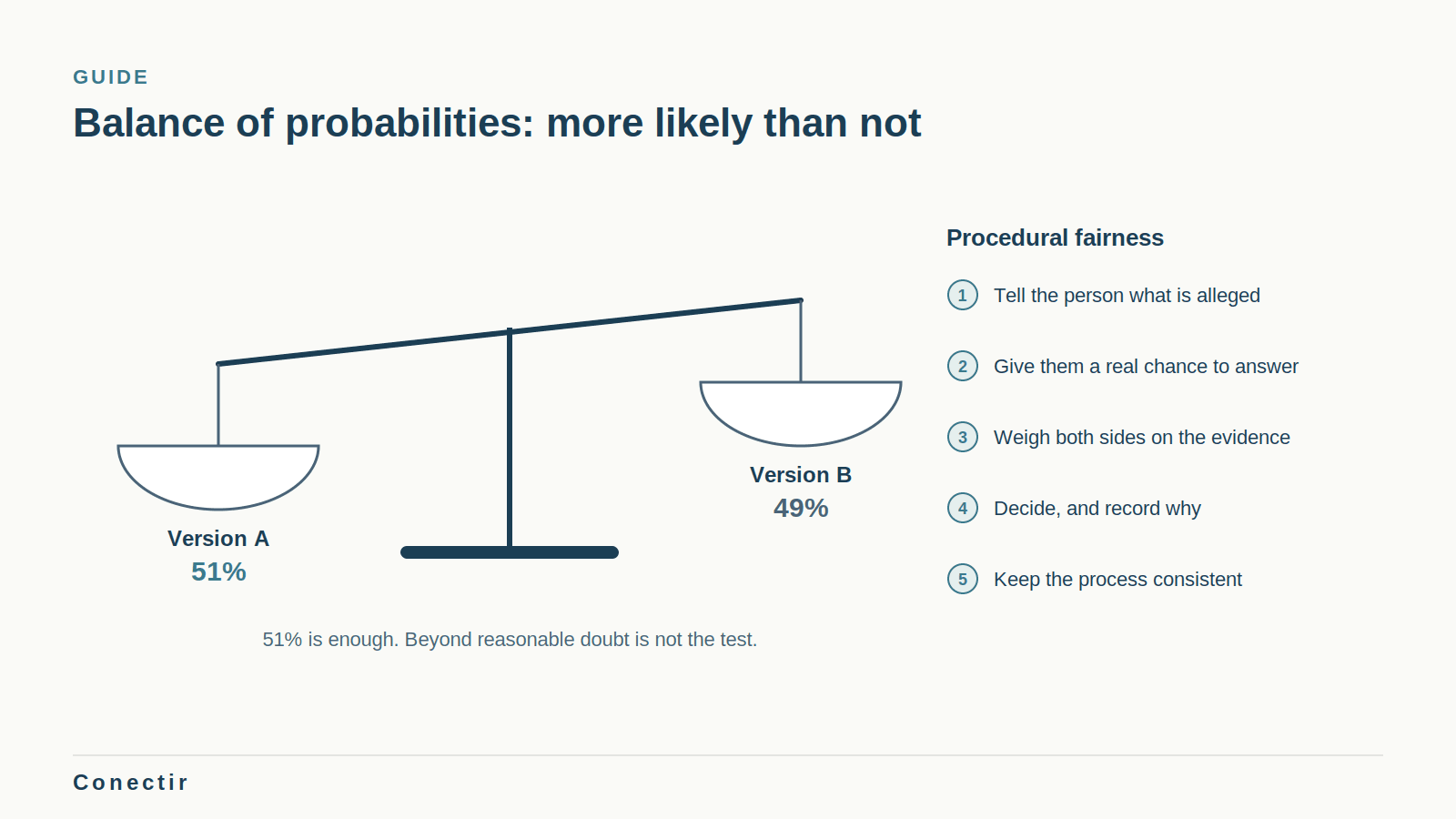
Workplace investigations are decided on the balance of probabilities, is it more likely than not that the misconduct occurred? This is a much lower bar than the criminal "beyond reasonable doubt," and understanding that difference changes how you work.
You do not need certainty. You do not need to eliminate every doubt. You need to be able to say, on the evidence, that the alleged conduct probably happened, 51% rather than 99%. This is deliberate: employment relationships are not criminal prosecutions, and the consequences, while serious, are not the same as a criminal conviction.
But, and this is the trap, a lower standard of proof does not mean a lower standard of process. You still have to gather real evidence, weigh it fairly, and reach a conclusion that a neutral reviewer would find reasonable. "More likely than not" still has to be founded on something. A conclusion pulled from thin air fails even the balance-of-probabilities test.
Procedural fairness: the part that actually gets tested
Here is the uncomfortable truth: most workplace cases that fall apart do not fall apart because the finding was wrong. They fall apart because the process was unfair. A tribunal or the CCMA can uphold a dismissal on thin evidence if the process was scrupulously fair, and overturn a well-founded one if it wasn't. So procedural fairness is where you should spend your care.
The core requirements, in plain terms:
The employee knows the allegation. Specifically. Not "misconduct" but "on 14 May you did X." You cannot answer a charge you haven't been told.
The employee gets a real chance to respond. Before any decision is made, they hear the evidence against them and are genuinely able to put their side, not as a formality after the outcome is already decided.
The investigation is impartial. The person investigating should not be the complainant, the decision-maker, or someone with a stake in the outcome. If those roles can't be fully separated in a small organisation, at least keep the investigation and the final decision in different hands.
Like cases are treated alike. Consistency matters. Dismissing one person for conduct that others got a warning for is a fairness problem regardless of the evidence.
The decision is based on the evidence gathered. Not on reputation, not on a prior grudge, not on what "everyone knows." Only on what the investigation actually established.
A fair sequence
A workplace investigation that holds up generally runs like this:
- Define the allegation precisely and record it.
- Plan the investigation: what evidence exists, who to interview, what documents to gather.
- Gather evidence, statements, documents, logs, CCTV, keeping a record of what you collected and when.
- Interview the employee about the allegation, putting the evidence to them and recording their response.
- Weigh it on the balance of probabilities, considering the innocent explanations as well as the incriminating ones.
- Report, findings of fact, then analysis, then a conclusion pitched to the correct standard, kept separate from any recommendation on sanction.
- Hand the decision on to someone other than the investigator wherever possible.
Where workplace investigations go wrong
- Prejudging. Deciding the outcome and then gathering evidence to support it. Reviewers can smell this, and it poisons everything.
- Not putting the evidence to the employee. Reaching a finding on evidence the employee never got to answer. This is the single most common fairness failure.
- Investigator wears too many hats. The same person complains, investigates and decides. Even if the finding is right, it looks, and often is, unfair.
- Vague allegations. Charging "poor conduct" instead of specific, dated acts, so the employee cannot mount a real defence.
- Ignoring exculpatory evidence. Recording only what fits the case. If the CCTV also shows something that helps the employee, it goes in the report.
- Inconsistency. Treating this employee more harshly than others were treated for similar conduct.
- Overstating the finding. Writing "the employee is guilty of theft" (a criminal-sounding conclusion) rather than "on the balance of probabilities, the employee removed the stock."
Consider the other side of the case, deliberately
The best protection against an overturned finding is to argue against yourself before anyone else does. For every strand of evidence pointing at the employee, ask what the innocent explanation is and whether the evidence still holds up once you've considered it. This isn't going soft, it's how you find the weak points while you can still fix them, rather than having the employee's representative find them for you at the hearing. A finding that has already survived the obvious counter-arguments is a strong finding.
Note on jurisdiction
The principles above, a civil standard of proof and a duty of procedural fairness, are common across many jurisdictions, but the specific rules, timelines and bodies differ. In South Africa, for example, unfair-dismissal disputes go to the CCMA and the requirements of the Labour Relations Act apply; other countries have their own tribunals and statutes. Always check the framework that governs your workplace before you rely on the detail. A separate guide covers the South African / CCMA context specifically.
Doing this fairly and consistently
Running a fair, well-reasoned workplace investigation, considering both sides of every point and pitching the conclusion correctly, is genuinely hard to do consistently, especially for managers who don't investigate for a living. Conectir's Council feature is built for exactly this: it reviews a case from several independent expert angles, surfaces the weaknesses, the gaps and the alternative explanations, and pre-fills the relevant jurisdiction so the labour context is considered. It pressure-tests your reasoning; it never returns a verdict of guilt. If you run workplace matters, see how the Council reviews a case.
Related guides
See how Conectir’s Case Council handles this on a real case — leads to verify, never a verdict.
Frequently asked questions
What is the standard of proof in a workplace investigation?
The balance of probabilities, whether the misconduct is more likely than not to have occurred. This is a lower bar than the criminal "beyond reasonable doubt," but the conclusion must still be founded on real evidence.
Why do workplace investigations get overturned?
Usually because of procedural unfairness rather than a wrong finding, vague allegations, not putting the evidence to the employee, prejudging, the investigator also being the decision-maker, or inconsistent treatment. Fair process often matters more than the strength of the evidence.
What does procedural fairness require?
That the employee knows the specific allegation, gets a genuine chance to respond before a decision, is investigated impartially, is treated consistently with similar cases, and that the decision rests only on the evidence gathered.
Should the investigator also decide the sanction?
Ideally no. Keeping the investigation and the final decision in separate hands protects the fairness of the process. In small organisations where that's difficult, at least separate the roles as far as possible.
How should a workplace investigation conclusion be worded?
To the civil standard and without criminal language, for example, "on the balance of probabilities, the employee removed the stock," not "the employee is guilty of theft." Keep the finding separate from any recommendation on sanction.