The Unexplained Wealth Toolkit: Net Worth and Source-and-Application Methods
Someone is living beyond their visible means. The car, the house, the holidays don't square with the salary. Proving it, in a way that survives a forensic accountant on the other side, takes more than a hunch. It takes one of the two classic indirect methods for estimating income: the net worth method and the source-and-application (expenditure) method. This guide explains both plainly and shows how they cross-check each other.
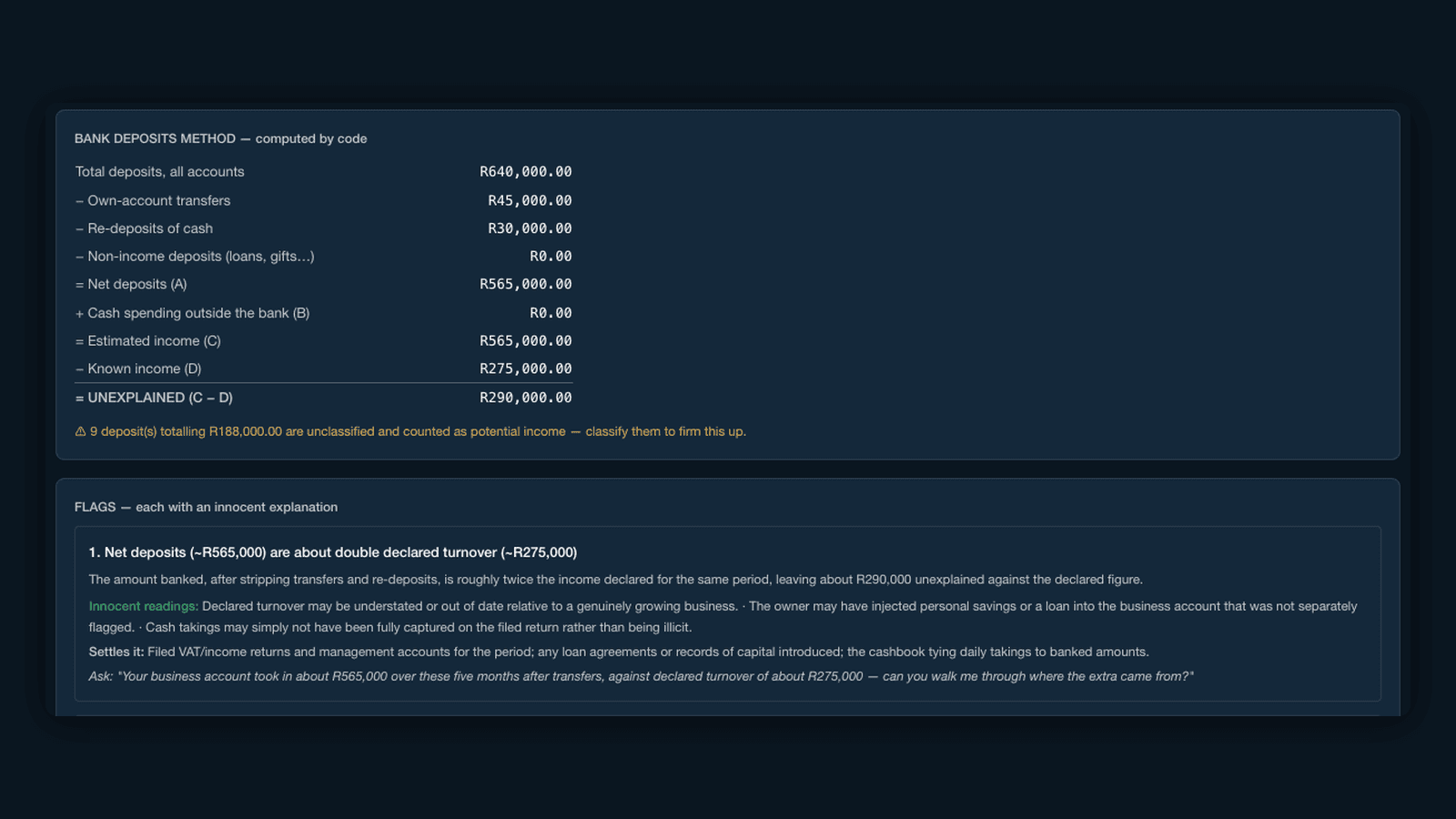
Both are called indirect methods because they don't rely on finding the hidden income directly. Instead they measure its footprints, the wealth it built up and the money it was spent on, and work backwards.
The net worth method
The logic is this: if your wealth grew by more than your known income could possibly account for, the difference came from somewhere you haven't declared.
Step 1, Establish opening net worth. Pick a starting date and total everything the subject owned (assets: property, vehicles, bank balances, investments, cash) and subtract everything they owed (liabilities: mortgages, loans, credit). That figure is their net worth at the start.
Step 2, Establish closing net worth. Do exactly the same at the end of the period.
Step 3, Calculate the increase. Closing net worth minus opening net worth is how much richer they got over the period.
Step 4, Add living expenses. They didn't only build wealth; they also lived. Add the cost of living for the period, rent or bond, food, school fees, travel, everything consumed.
Step 5, Compare to known income. The increase in net worth plus living expenses is the total amount of money the subject must have had available. Set that against their known, legitimate income. The gap is the estimate of unexplained income.
In one line: (closing net worth − opening net worth) + living expenses − known income = unexplained income.
The source-and-application (expenditure) method
This one approaches the same truth from the spending side. It asks: where did all the money that flowed out come from?
Application of funds is everything the money was used for over the period: assets bought, debts repaid, living expenses, cash spent.
Source of funds is everything that legitimately funded it: known income, loans drawn, gifts received, savings run down, assets sold.
If applications exceed sources, if the subject spent more than every legitimate source can explain, the difference is unexplained. In one line: total applications − total legitimate sources = unexplained funds.
Why run both
The two methods are different lenses on the same reality, and they should roughly agree. The net worth method is strong when the subject accumulates assets; the expenditure method is strong when they spend it all as fast as it comes in and never build visible wealth. Run both, and if they converge on a similar unexplained figure, your conclusion is far more robust. Add the bank deposits method (covered in a separate guide) as a third check and the convergence becomes very hard to argue with.
The innocent explanations you must test, every time
Indirect methods are estimates built on assumptions, and the defence will attack the assumptions. Before you present an unexplained figure, work through, and where possible close off, every innocent source of wealth:
- A loan. Borrowed money funds lifestyle without being income. Get the loan agreements.
- A gift or inheritance. Family money is real and common. Ask.
- Prior cash savings. The classic defence: "I had cash saved up before your starting date." This is why establishing opening net worth accurately, including any cash hoard, matters so much. A defensible opening position closes this door.
- Asset sales. Selling a car or shares generates spending power that isn't income.
- Undervalued opening assets or overvalued closing ones. If your valuations are off, your gap is an artefact of your own errors. Value consistently and conservatively.
- Someone else's money. Assets or cash held on behalf of a spouse, a business, or a family arrangement.
The finding you can defend is: "After accounting for all identified legitimate sources, the subject had access to funds of approximately X that remain unexplained." Never "the subject is corrupt." You are producing a lead, a figure the subject must account for, not a verdict.
Getting the opening position right is everything
If you take one thing from this guide, take this: the whole analysis stands or falls on the opening net worth. An investigator who cannot establish a solid starting point leaves the "I already had it saved" defence wide open, and the entire estimate collapses. Spend your effort here. Nail the opening assets, liabilities and, critically, any cash the subject genuinely held before the period. A conservative, well-evidenced opening position is what makes the closing gap mean something.
Keeping it defensible
These methods end up in front of experts. Document the source of every asset and liability value, state your assumptions openly (especially the living-expenses estimate and the cash position), show the arithmetic in full, and list every innocent source you tested and either accepted or ruled out. Transparency about the method's limits is not weakness, it is what makes the parts you are confident about credible.
Doing the arithmetic without losing the thread
Net worth and expenditure analyses involve a lot of moving parts, asset schedules, liability schedules, living-cost estimates, multiple periods, and the cross-check between methods. Doing it by hand invites both arithmetic errors and inconsistent assumptions. Conectir's financial tools help you build the asset and liability picture, pull figures from bank statements and documents, and run the net worth and source-and-application calculations with every sum shown in plain sight for you to verify. It surfaces the unexplained gap and lets you attach the innocent explanations you tested; it never labels the wealth criminal. If unexplained-wealth work is part of your caseload, see how the financial analysis handles it.
Related guides
See how Conectir’s financial analysis tools handles this on a real case — leads to verify, never a verdict.
Frequently asked questions
What is the net worth method?
It estimates unexplained income by measuring how much a person's net worth (assets minus liabilities) grew over a period, adding their living expenses, and subtracting their known legitimate income. The remaining gap is the estimate of unexplained income.
What is the source-and-application of funds method?
Also called the expenditure method, it totals everything the money was spent on (applications) and everything that legitimately funded it (sources). If applications exceed sources, the difference is unexplained funds.
Which method should I use?
Ideally both, plus the bank deposits method. The net worth method suits people who accumulate assets; the expenditure method suits people who spend everything. When the methods converge on a similar figure, the conclusion is far stronger.
What is the most common defence to these methods?
That the subject had cash saved before the period began. This is why establishing an accurate, well-evidenced opening net worth, including any genuine cash hoard, is the most important part of the whole analysis.
Does an unexplained gap prove corruption or fraud?
No. The gap is an estimate that the subject must account for. Loans, gifts, inheritances, asset sales and prior savings can all explain it. Present it as unexplained funds after testing legitimate sources, a lead, not a verdict.