Timeline Reconciliation: Building One Clear Sequence From Many Accounts
Most investigations come down to sequence: what happened, in what order, and who was where when. Scattered across a handful of statements, that sequence is invisible. Reconciled into a single timeline, it becomes the backbone of the whole case, the thing you test every new piece of evidence against. This guide is about building that timeline properly.
Why the timeline is the backbone
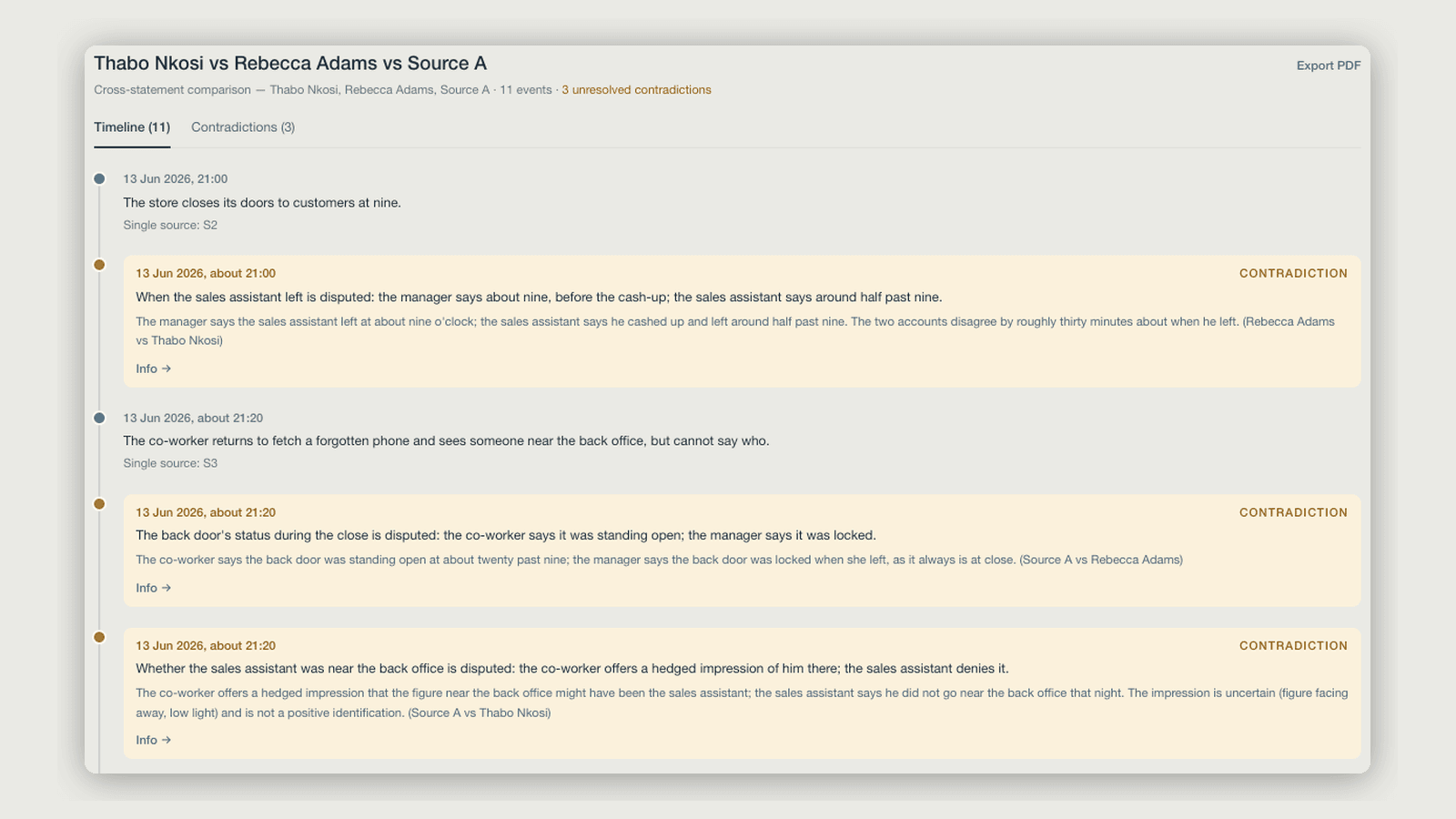
A timeline does something no individual statement can: it shows you the whole event from above. Once every account is placed on one sequence, three things you can't otherwise see light up. You see where accounts agree, corroboration. You see where they clash, contradiction. And you see where nobody's looking, the gaps in coverage where something could have happened unobserved. Those three are the raw material of an investigation, and the timeline is what surfaces them.
It also disciplines your own thinking. A timeline forces you to be concrete about time and order, which is exactly where loose reasoning hides. "Roughly that afternoon" won't sit on a timeline; it forces the question "when, exactly, and how do we know?"
Step 1: Extract time-anchored events from each account
Go through each statement and pull out every event tied to a time, a place or a person. Write each as a short, single-fact line: 14:00, truck arrives, David. Do this separately for each source before you merge anything, so each account's own internal order stays intact.
Keep the source attached to every event, which statement, ideally which line. You'll need it constantly, and a timeline you can't trace back to sources is a timeline no one will trust.
Step 2: Grade the precision of every time
Not all times are equal, and pretending they are will wreck your reconciliation. Grade each one:
- Exact: "at 14:00," "at 06:30."
- Approximate: "around 2," "just after lunch-ish."
- Relative: "after the delivery," "before she left", only locatable once you know when the other event happened.
- Vague: "that afternoon," "later."
This grading matters because a clash between two exact times is significant, while a clash between two vague ones is almost meaningless. And relative times can be anchored: "after the delivery" becomes a real time once you've placed the delivery. Working out the relative times against the fixed ones is where a lot of the reconciliation actually happens.
Step 3: Merge into one sequence
Now lay all the events from all sources onto a single line, in order. Where two sources describe the same event, put them on the same entry. As you do this, four statuses emerge for each event:
- Corroborated, multiple independent sources, agreeing. Strongest, provided the sources are genuinely independent.
- Single-source, only one account mentions it. Not suspicious in itself, but unconfirmed.
- Soft contradiction, sources differ, but within the margin of honest memory (a rounded time, a small discrepancy).
- Hard contradiction, sources clash in a way that can't both be true.
Step 4: Find the gaps
This is the step people skip, and it's often where the case is. Look at your merged timeline and find the windows where no account has coverage, stretches of the relevant period that no witness describes. A gap isn't evidence of anything by itself, but it's where unobserved things happen. If the theft, the meeting, the phone call had to occur somewhere, an uncovered window is a candidate, and it's a pointed question: "what was happening between 11:00 and 11:30, and who can tell us?"
Step 5: Resist the urge to resolve contradictions yourself
When two accounts clash, it's tempting to decide then and there which one is right and write the "correct" version onto your timeline. Don't. The timeline's job is to show the contradiction faithfully, both versions, both sources, clearly flagged, not to adjudicate it. Which account is correct is a conclusion you reach later, from follow-up and other evidence, and it belongs in your analysis, not baked silently into the sequence. A timeline that quietly picks winners is a timeline that has smuggled your assumptions in where a reviewer can't see them.
The same discipline applies to the innocent explanation: a hard contradiction on the timeline is a flag to investigate, not a finding that someone lied. Rounding, vantage and memory explain most clashes. The timeline surfaces them; you test them.
Step 6: Use the timeline as a living document
A good timeline isn't built once and filed. It's the workbench for the whole investigation. Every new statement adds events to it. Every document, a swipe-card log, a CCTV timestamp, a phone record, gets tested against it, and often nails down a previously vague or relative time. Contradictions get resolved and annotated as follow-up comes in. By the end, the timeline is both your analytical tool and a large part of your evidence: a clear, sourced sequence a reader can follow and check.
Keeping it defensible
Because the timeline often becomes central to the report, build it so it can be scrutinised. Every event traceable to its source. Every contradiction shown, not hidden. Precision of each time visible, so no one mistakes a guess for a fact. Gaps acknowledged rather than papered over. A reconciliation you can hand to a lawyer and say "check any line against its source" is worth ten times one that only makes sense in your own head.
Doing this without hours of manual cross-referencing
Extracting events, grading times, anchoring relative references, merging sources and spotting every clash and gap is exactly the kind of careful, mechanical work that eats an afternoon per case and where a tired eye misses things. Conectir's timeline builder was created for this specific job: paste in the statements and it extracts the time-anchored events, merges them into one chronological view, flags corroborations, hard and soft contradictions, single-source events and coverage gaps, and keeps the source quote on every entry. It builds the reconciliation and shows its working; the judgement on what the clashes mean stays with you. It's the feature Conectir was built around, see how it handles a multi-statement case.
Related guides
See how Conectir’s timeline builder handles this on a real case — leads to verify, never a verdict.
Frequently asked questions
What is timeline reconciliation?
It's the process of combining several accounts of an event into one chronological sequence, so you can see where they corroborate each other, where they contradict, and where there are gaps in coverage. It's usually the backbone of an investigation.
How do I build an investigation timeline from witness statements?
Extract every time-anchored event from each statement, grade how precise each time is, merge them onto one sequence tagged by source, flag corroborations and contradictions, and identify the windows no account covers.
How do I handle vague or relative times?
Grade each time as exact, approximate, relative or vague. Relative times ("after the delivery") can often be anchored to a real time once you've placed the event they refer to. Never treat a vague time as if it were exact.
Should I decide which account is correct when building the timeline?
No. Show contradictions faithfully, both versions, both sources, clearly flagged, rather than silently choosing a winner. Which account is right is a conclusion for your analysis, reached from follow-up and other evidence.
Why are gaps in the timeline important?
Because uncovered windows, stretches no account describes, are where unobserved events can happen. A gap isn't evidence by itself, but it points you to what to investigate and who might be able to fill it.