The 10 Contradictions Checklist: What to Flag When Statements Don't Line Up
Not every difference between two accounts is worth your attention. If you chase all of them, you drown; if you chase none, you miss the one that matters. This is a working checklist of the ten kinds of contradiction that are actually worth flagging in an investigation, and, just as importantly, the innocent explanation to consider for each before you treat it as significant.
Print it, keep it beside you, and run every pair of statements through it.
1. Time contradictions
Two accounts put the same event at incompatible times: "he left at 17:00" versus "he was still here at 18:00." Flag it when both times are specific and both witnesses were well-placed to know. Innocent explanation: people round, estimate and misremember times constantly. A one-hour gap between two firm times is worth chasing; ten minutes between two guesses is not.
2. Sequence contradictions
The events are agreed, but the order is different. One says the alarm sounded before the lights went out; the other says after. Order can matter enormously, cause and effect often hang on it. Innocent explanation: memory reorders events, especially fast-moving or stressful ones. Ask each witness what anchored the sequence in their mind.
3. Place contradictions
The same person or object is placed in two different locations at the same time. This is one of the harder contradictions to explain away and often one of the most productive. Innocent explanation: vague location language ("out back," "near the office") can describe the same spot in different words. Pin down exactly what each witness means before flagging.
4. Presence contradictions
One witness says a named person was there; another who should have seen them does not mention them at all. This is the contradiction of omission, and it is easy to miss because nothing is directly denied. Innocent explanation: people simply don't list everyone present. It only becomes significant when the missing person is central, for example, when an alibi depends on someone the alibi-giver's own witness never places at the scene.
5. Action contradictions
The accounts disagree about who did something. "Susan told me to move the pallet" versus a statement from Susan that never mentions any such instruction. Innocent explanation: instructions get misattributed and misremembered. But a specific, consequential action claimed by one and flatly absent from the other is a strong lead.
6. Quantity and detail contradictions
Numbers that should match don't: how much cash, how many boxes, how many people. Detail contradictions are useful because numbers are harder to fudge honestly than impressions. Innocent explanation: estimating quantities under pressure is unreliable. Distinguish a counted figure ("I signed for 12") from an eyeballed one ("looked like a dozen").
7. Sensory contradictions
What each witness claims to have seen or heard, given where they were standing. One claims to have heard a conversation from across a noisy warehouse; the physical layout makes that unlikely. Innocent explanation: people overstate what they perceived, often without meaning to. Check the claim against the physical facts, distance, noise, sightlines, rather than against the other statement alone.
8. Self-contradiction within one statement
The clash is not between two witnesses but inside a single account: the writer says one thing early and something incompatible later. This is often more telling than any cross-witness difference. Innocent explanation: long statements drift, and people correct themselves mid-flow. Look at whether the two versions serve different purposes for the writer.
9. Contradiction with the physical or documentary record
A statement clashes not with another witness but with a timestamp, a swipe-card log, CCTV, or a signed document. These are the strongest of all because the record does not have a memory to blame. Innocent explanation: clocks and systems can be wrong or mis-set. Verify the record's own reliability before treating it as the fixed point.
10. Contradiction by evolution
The same witness's account changes across successive tellings, the first interview, the written statement, a later clarification. Movement in an account over time is a flag in itself. Innocent explanation: recollection genuinely improves with reflection, and later detail is not automatically suspect. What matters is the direction of the change and whether it conveniently tracks what the witness has since learned.
The rule that ties the checklist together
Every item above pairs a flag with an innocent explanation on purpose. That pairing is the discipline. A contradiction is a question, not a finding of dishonesty. Your job at this stage is to surface the differences, note the innocent reading, and decide which ones survive that test well enough to be worth a follow-up question or a check against other evidence.
An investigator who presents a list of "lies" gets dismantled the moment a defence lawyer offers the obvious innocent explanation. An investigator who says "I found these differences, I considered these innocent explanations, and I still thought these three needed answering" is doing the job properly.
From checklist to action
Work through the ten points, mark what fires, and for each one that survives the innocent-explanation test, write the follow-up question it raises. That question list, not a verdict, is the real output. It tells you who to re-interview, what to ask them, and which other evidence to pull.
Doing this consistently across a case
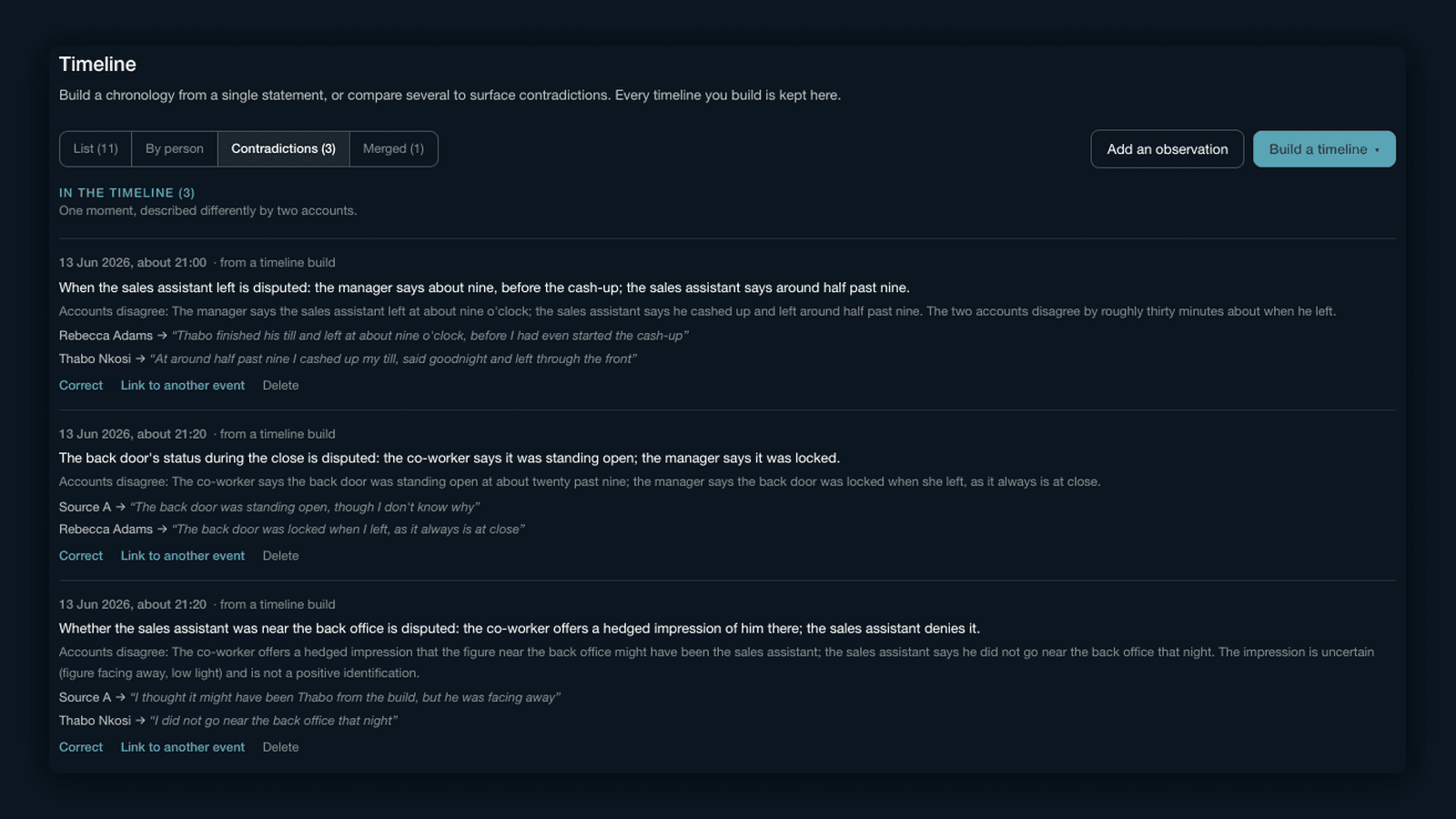
Running this checklist by hand is fine for two statements. Across four or five accounts of the same event, keeping every pairing straight is where errors creep in, a missed omission here, a sequence clash overlooked there. Conectir's timeline builder applies this logic automatically when it merges multiple statements: it flags time and sequence clashes as hard or soft contradictions, marks single-source events, catches uncorroborated-presence gaps, and attaches the source quote to each so you can judge it yourself. It does the surfacing; the judgement stays yours. You can see how it handles a multi-statement case.
Related guides
See how Conectir’s timeline builder handles this on a real case — leads to verify, never a verdict.
Frequently asked questions
What are the main types of contradiction in witness statements?
The common categories are time, sequence, place, presence (omission), action, quantity, sensory, self-contradiction within one statement, contradiction with the physical or documentary record, and evolution of an account over time.
Does a contradiction mean a witness is lying?
Not on its own. Most contradictions have an innocent explanation, forgetting, rounding, a different vantage point, or genuine memory reordering. Treat each as a question to test, ruling out the innocent reading before treating it as significant.
Which contradiction is the strongest?
A statement that clashes with a reliable physical or documentary record, a timestamp, swipe-card log, or signed document, is usually the strongest, because the record has no memory to blame. Verify the record's own reliability first.
What is a contradiction of omission?
It is when one account is silent where you would expect it to speak, most importantly when an alibi relies on a person whose own statement never places them at the scene. Nothing is directly denied, which is why it is easy to miss.
How should I record contradictions I find?
For each flag, record the contradiction, the innocent explanation you considered, and the follow-up question it raises. This shows a fair, defensible method rather than a rush to judgement.