SCAN Statement Analysis: What It Is, What It Isn't, and the Leads-Not-Verdicts Rule
SCAN, Scientific Content Analysis, is a method for examining the language of a written statement to find places worth asking about. It has passionate advocates and serious critics, and both have a point. This guide explains what SCAN actually is, what it can and cannot do, and the one rule that keeps it useful instead of dangerous: it produces leads, not verdicts.
What SCAN is
SCAN is a technique, developed by Avinoam Sapir, for analysing a person's own written account of an event. The core idea is that how someone tells their story, the words they choose, what they include, what they leave out, where they change tense or pronoun, can point to parts of the account that deserve closer attention.
The method asks the subject to write a full, uninterrupted account in their own words, and then examines the text for a set of linguistic features, or "markers." Crucially, it works on the subject's own language, not on questions you put to them, the theory being that unprompted word choices reveal more than answers to leading questions.
What the markers actually flag
SCAN practitioners look at features such as:
- Pronoun changes. Dropping "I," or switching from "we" to "I" (or the reverse), can mark a shift in commitment or relationship at a particular point in the account.
- Tense shifts. Slipping from past tense into present tense when describing a past event is treated as worth noting, sometimes it accompanies parts of a story that weren't actually experienced as described.
- Missing or "skipped" time. Phrases like "later," "after that," "the next thing I remember" can compress or step over a period the subject would rather not detail.
- Unnecessary connectors. Words like "then," "afterwards," "so" sometimes appear where time has been jumped.
- Changes in how people or objects are referred to. A wife who becomes "that woman," a car that becomes "the vehicle", changes in naming can mark changes in the subject's stance.
- Spontaneous corrections, hedges and qualifiers. "To be honest," "as far as I recall," self-edits mid-sentence.
- Where the account puts its detail. Statements often have an out-of-balance structure, lots of detail on the run-up, very little on the event itself, then a long wind-down.
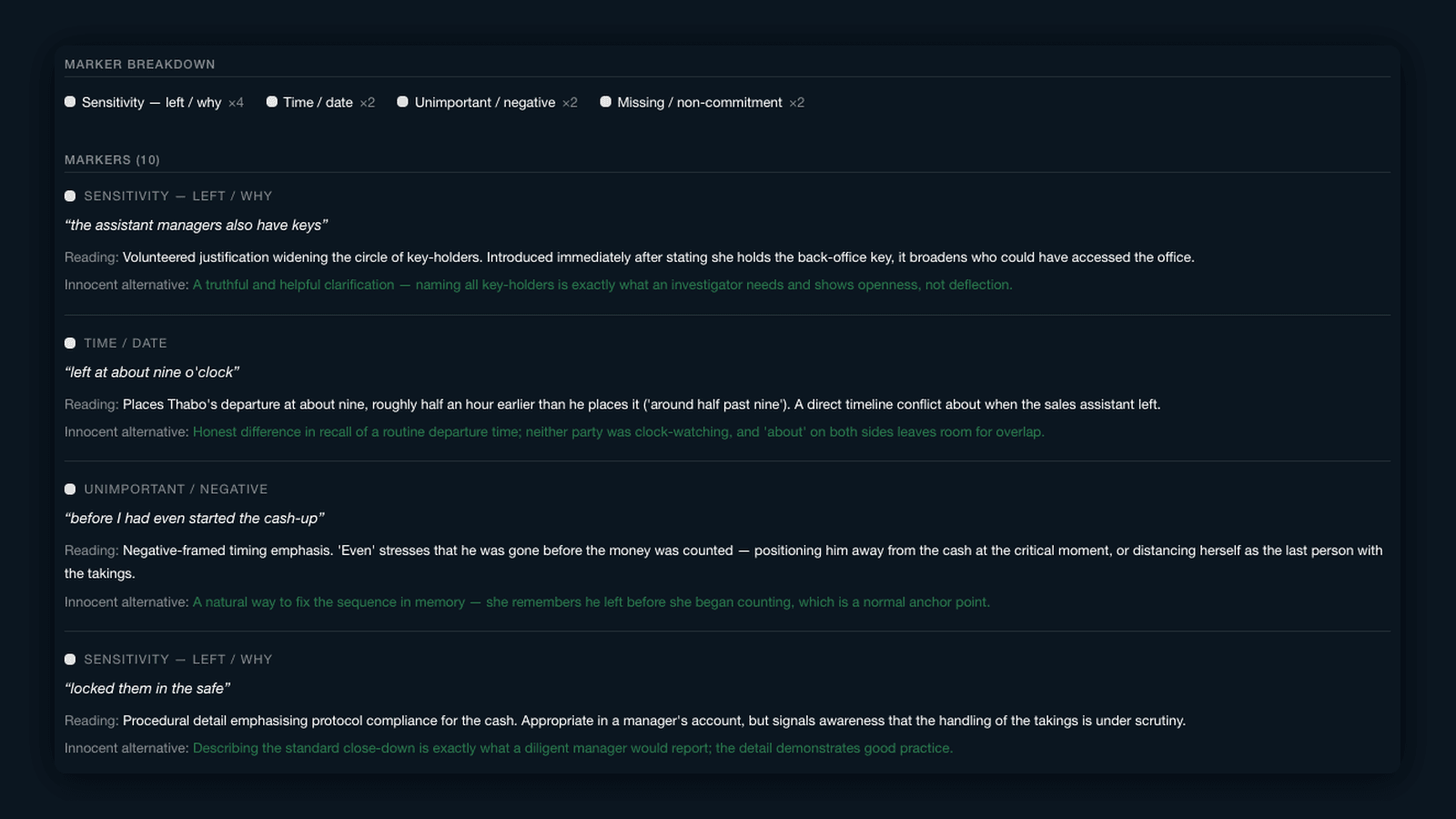
Each of these is a marker: a spot in the text that stands out and may be worth a question. None of them, on its own, means anything conclusive.
What SCAN is NOT
This is the part practitioners of integrity are clear about, and the part critics rightly hammer:
SCAN is not a lie detector. No linguistic marker reliably distinguishes truth from deception. The peer-reviewed research on SCAN's accuracy is, at best, mixed, and several studies find it performs no better than chance at classifying statements as truthful or deceptive. Anyone selling SCAN as a way to tell if someone is lying is overselling it.
A marker is not a finding. Every single marker has an innocent explanation. People drop pronouns because that's how they talk. People shift tense because they're reliving something vividly. People skip time because nothing happened, or because they're embarrassed about something unrelated, or because they're a poor writer. Treating a marker as proof of deception is the cardinal error.
It doesn't work well on speech, translations, or heavily edited text. SCAN is built for a subject's own, freely written words. Run it on a transcript someone else typed up, a translated statement, or a lawyer-polished account, and the "markers" may be artefacts of the process, not the person.
The rule that makes it safe: leads, not verdicts
Used honestly, SCAN is not a truth machine, it is an attention-directing tool. Its real value is that it points you at the specific parts of a long statement worth probing, so you don't have to interview blind. The marker doesn't tell you the answer; it tells you where to ask the question.
So the disciplined workflow is:
- Get a clean, freely written statement.
- Note the markers, the places the language stands out.
- For each marker, write down the innocent explanation as well as the suspicious one.
- Turn the marker into a question, not a conclusion: "You wrote 'later I went home', walk me through exactly what happened between leaving the office and getting home."
- Let the answers, and the other evidence, do the deciding.
The output of a SCAN pass should be an interview plan, not an accusation. That's the leads-not-verdicts rule, and it is what separates responsible statement analysis from pseudoscience.
How to keep it credible
If you use SCAN, use it as one input among many and never as the basis for a decision on its own. Never write "the statement analysis shows the subject was deceptive" in a report, that claim isn't supportable and it will be demolished. Write instead that "the statement contained the following features, which were explored in interview," and let the interview and the corroborating evidence carry the weight. Anchor every conclusion in facts you can point to, not in linguistic hunches.
Where SCAN fits with everything else
Statement analysis is most powerful when it feeds the rest of the investigation rather than standing alone. The markers tell you what to ask; the interview answers get tested against the timeline; the timeline gets tested against the documents. SCAN is the first filter, not the verdict. A separate guide covers building the interview around what the analysis surfaces.
Doing a SCAN pass without months of training
Reading a statement for markers by hand takes training and time, and it's easy to either miss features or over-read them. Conectir's SCAN tool marks up a statement, lists the features it found, and, importantly, attaches an innocent alternative to every marker, then turns them into suggested interview questions. It never returns a verdict of deception; it produces the leads and the interview plan and leaves the judgement to you. That built-in restraint is the point. If statement analysis is part of your work, see how the SCAN tool handles a statement.
Related guides
See how Conectir’s SCAN statement analysis handles this on a real case — leads to verify, never a verdict.
Frequently asked questions
What is SCAN (Scientific Content Analysis)?
It is a method for analysing a person's own written statement for linguistic features, pronoun and tense changes, missing time, changes in how people are referred to, that mark parts of the account worth exploring further.
Can SCAN detect lies?
No. No linguistic marker reliably distinguishes truth from deception, and the research on SCAN's accuracy is mixed at best. It should be used to direct attention and generate questions, not to judge truthfulness.
What are SCAN markers?
Points in a statement where the language stands out, dropped pronouns, tense shifts, skipped time, unusual connectors, changes in naming, hedges and self-corrections. Each is a place that may be worth a question, not evidence of anything on its own.
Does a marker mean the person is lying?
No. Every marker has an innocent explanation, natural speech habits, vivid recall, poor writing, or embarrassment about something unrelated. A marker should become a follow-up question, never a conclusion.
How should SCAN be used responsibly?
As one input among many that directs your interview. Never base a decision on it alone, never state in a report that analysis "showed deception," and always pair each marker with the innocent explanation before turning it into a question.