Pressure-Testing Your Own Case Before the Defence Does
Every case has weaknesses. The only question is whether you find them or the other side does. Investigators fall in love with their own theories, it's human, and it's dangerous. The antidote is to deliberately attack your own case before anyone else gets the chance. This is red-teaming, and done properly it's one of the highest-value hours you can spend on any investigation.
Why you can't see your own weak points
Confirmation bias isn't a character flaw; it's how brains work. Once you form a theory, you unconsciously weight the evidence that supports it and discount the evidence that doesn't. You remember the witness who backed your view more vividly than the one who muddied it. You read an ambiguous document in the light of what you already believe. By the time your case feels solid to you, you've stopped seeing the cracks, not because you're careless, but because you're close to it.
Red-teaming is the structured way to break out of that. You stop being the prosecutor for a while and become the defence. The goal is not to talk yourself out of the case; it's to find every hole while there's still time to fill it.
The core question: what would the defence say?
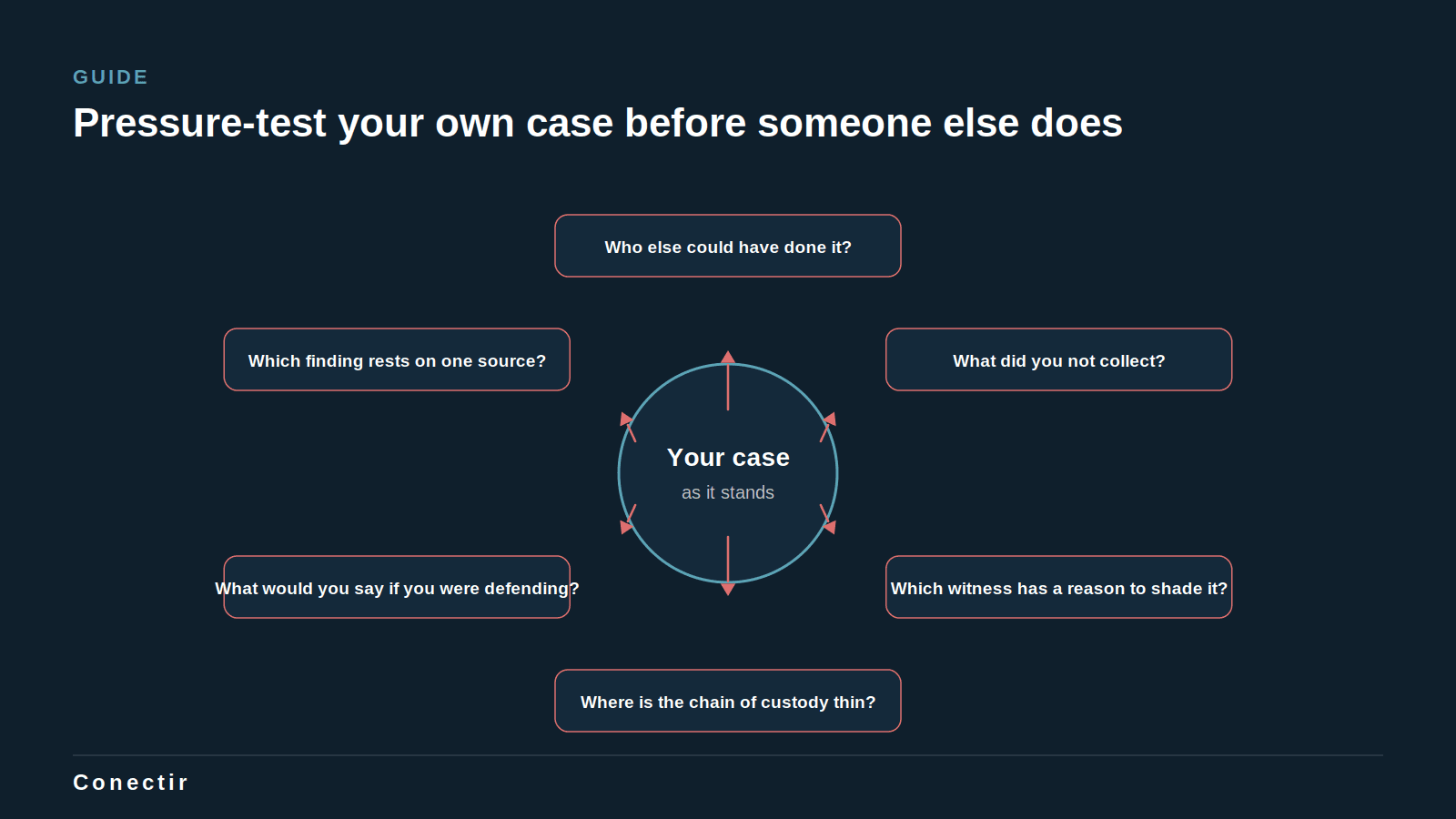
Take your central conclusion and imagine the sharpest possible opponent reading it. For every piece of evidence and every inference, ask: how would they attack this? Work through it honestly, without flinching. The attacks tend to fall into a few families.
"There's an innocent explanation." For every incriminating fact, what's the most plausible benign reading? If the innocent explanation is genuinely as strong as yours, that fact isn't carrying the weight you thought. The strongest case is one where you've named the innocent explanation and can say precisely why the evidence still points the other way.
"That evidence shouldn't be admitted." How was it obtained? Is the chain of custody intact? Was a statement taken properly? Was anything gathered in a way that a court would exclude? Evidence that gets thrown out is worse than evidence you never had, because you built on it.
"Your witness isn't reliable." What's the witness's motive, vantage point, consistency, and history? Where could their account be shaken? A case resting on a witness who crumbles under cross-examination is a case resting on sand.
"You didn't investigate X." What lines of inquiry did you not follow? A gap in the investigation, an obvious witness you never interviewed, a document you never pulled, is something the other side will hold up as reasonable doubt or as evidence of a rushed, biased process.
"The inference doesn't follow." Does your conclusion actually follow from your facts, or is there a leap? Where you've inferred motive, intent or knowledge, is that the only reasonable reading of the facts, or just the one you prefer?
A structured red-team method
Freelancing "what could go wrong" tends to be shallow. A structure forces you to be thorough:
- State your case in one paragraph, the conclusion and the two or three pillars it rests on.
- Attack each pillar in turn. For each, write the strongest counter-argument you can genuinely make, not a straw man.
- List the alternative explanations for the case as a whole. If someone else did it, or nothing wrong happened at all, what would the evidence look like, and does it look like that?
- Audit the admissibility of every key piece of evidence.
- Map the gaps, the inquiries not made, the questions not asked.
- Rate the case honestly, not "strong/weak" as a gut feeling, but where specifically it's strong and where it's exposed.
- Turn each weakness into an action, the interview to redo, the evidence to shore up, the alternative to close off.
The output isn't a verdict on whether you're right. It's a to-do list that makes the case harder to break.
Get other eyes on it
Your own red-teaming is limited by your own blind spots, the same ones that created the problem. The single best thing you can do is have someone who wasn't involved in the investigation try to knock it down. A colleague, ideally one with a different specialism, will spot things you're structurally unable to see. If you can get several different perspectives, someone thinking like a defence lawyer, someone thinking like a forensic accountant, someone thinking about process and fairness, you approximate the range of attacks a real case will face.
The trick is to genuinely invite the criticism, not to defend against it. If you argue with every point your reviewer raises, you've wasted the exercise. Write the criticisms down as though they're already coming from the other side, because soon enough they will be.
Red-teaming is not self-sabotage
Some investigators resist this because it feels like undermining their own work. It's the opposite. A case that has survived a serious internal attack is a genuinely strong case, and you know why it's strong, and where its remaining limits are, which is exactly what you need to present it honestly. A case that has never been challenged just hasn't met its challenge yet. Better the challenge comes from your side of the table, on a day when you can still do something about it.
And there's an integrity dividend: an investigator who has honestly considered the alternatives and can articulate why the evidence still points where it does is far more credible than one who only ever built the case one way. Fairness and strength turn out to be the same thing.
Doing this systematically
Red-teaming well means holding several hostile perspectives at once and being honest about your own weak points, genuinely hard to do alone and under time pressure. Conectir's Council feature is built for exactly this: it runs a case past a panel of independent expert reviewers, a defence angle, an investigator's angle, a due-process angle, and specialists where the evidence calls for them, who surface the weaknesses, the gaps, the alternative explanations and the admissibility risks, then synthesise it into next steps. It never returns a verdict of guilt; it produces a calibrated read on where the case is strong and where it's exposed. If you want your cases pressure-tested before the other side does it, see how the Council works.
Related guides
See how Conectir’s Case Council handles this on a real case — leads to verify, never a verdict.
Frequently asked questions
What does it mean to red-team an investigation?
It means deliberately attacking your own case as an opponent would, finding the weaknesses, alternative explanations and admissibility problems yourself, before the defence does, while there's still time to address them.
Why can't I just judge my own case objectively?
Because of confirmation bias: once you have a theory, you unconsciously favour supporting evidence and discount the rest. A structured red-team method, and other people's eyes, are how you get past your own blind spots.
What questions should I ask when pressure-testing a case?
For each piece of evidence: what's the innocent explanation, is it admissible, is the witness reliable, what didn't I investigate, and does my inference actually follow from the facts? Attack each pillar of the case with the strongest genuine counter-argument.
Does finding weaknesses mean my case is bad?
No. Every case has weaknesses. Finding and addressing them makes the case stronger and your presentation more credible. A case that has never been challenged simply hasn't met its test yet.
Should someone else review my case?
Yes, wherever possible. A reviewer who wasn't part of the investigation, ideally several, with different specialisms, will spot problems you're structurally unable to see. Invite the criticism rather than defending against it.