Preparing a Case for Prosecution: The Handover Pack That Holds Up
There's a gap between a good investigation and a case a prosecutor can actually run. Plenty of solid investigations stall at that gap because the handover was a heap of documents and a verbal summary. A prosecutor is busy, sceptical, and thinking about what a defence will do to the case. Your job at handover is to hand them something they can pick up, understand fast, and take forward with confidence. This guide is about building that pack.
Think like the person receiving it
Before you assemble anything, put yourself in the prosecutor's chair. They need to answer three questions quickly: What's the allegation? What's the evidence for each element of it? Where is it weak? A handover pack organised around those questions gets read and acted on. A pack that's just a chronological dump of everything you gathered gets put to the bottom of the pile, because someone else has to do the work of making sense of it.
The pack is an act of translation: from your understanding of the case, built over weeks, into a form someone can absorb in an hour.
Start with the case theory
Open with a clear, short statement of the case theory: what you say happened, who did it, and why it amounts to the offence in question. This is the spine everything else hangs off. If you can't state the theory in a paragraph, the case isn't ready, and better to discover that now than in front of a magistrate.
Keep it factual and measured. "The evidence indicates that between X and Y dates, the accused did Z, which the following establishes." Not "the accused is a serial thief who finally got caught." Overstatement here signals to a careful prosecutor that your judgement can't be trusted, which colours how they read everything that follows.
Map the evidence to the elements
This is the heart of a prosecution-ready pack and the part investigators most often skip. Every offence breaks down into elements, the specific things that must each be proven for the offence to stand. Theft, for instance, requires (broadly) that property belonging to another was taken, without consent, with the intent to permanently deprive. A prosecutor has to prove every element, so your pack should show, element by element, which evidence supports it.
Lay it out as a schedule: for each element of the offence, list the evidence that goes to it, this statement, that document, this exhibit. Two things immediately become visible. Where you have several independent items pointing at an element, it's solid. Where an element rests on one shaky witness, or on nothing at all, that's the hole, and it's far better that you spot it and flag it than that the prosecutor discovers it after charging.
Build a clean evidence schedule
The prosecutor needs to find any piece of evidence in seconds. Provide an indexed schedule: each exhibit numbered, described, with its source, the date it was obtained, its chain-of-custody status, and where it sits in the pack. A statement should show who made it, when, and be paginated so people can refer to "page 4, line 12." Disorganised evidence reads as a disorganised investigation, and it makes the prosecutor's cost of running the case higher than it needs to be.
Be honest about the weaknesses
Counter-intuitively, the section that builds the most trust is the one where you set out the problems: the contradictions you couldn't resolve, the witness with a credibility issue, the evidence with a chain-of-custody question mark, the alternative explanation you couldn't fully close off. A prosecutor is going to find these anyway, and if the defence finds them first because you buried them, you've damaged the case and your own credibility.
Flagging weaknesses honestly does the opposite. It lets the prosecutor make an informed charging decision, prepare for the attacks, and trust that what you've not flagged is genuinely sound. This is the leads-not-verdicts discipline carried all the way to handover: you're presenting evidence for a decision, not selling a conviction.
Handle disclosure properly
In most systems the prosecution has a duty to disclose to the defence material that could undermine the case or assist the accused, including things that came up in the investigation and point the other way. Your pack must therefore capture everything relevant, not just the incriminating material: the statement that helped the accused, the line of inquiry that went nowhere, the evidence you decided not to rely on. Failing to disclose can collapse a case entirely and can be a serious impropriety. Flag potential disclosure material clearly so the prosecutor can meet the duty. The specifics vary by jurisdiction, so know the disclosure rules that apply where you are.
Tie up the loose ends, or list them
Before handover, resolve what you can: the follow-up interview you meant to do, the document you never chased, the witness detail that's still vague. What you genuinely can't resolve, list, as outstanding actions, so the prosecutor knows the state of play rather than assuming completeness. A pack that quietly leaves gaps unmarked is worse than one that says plainly "the following remain outstanding."
A handover pack checklist
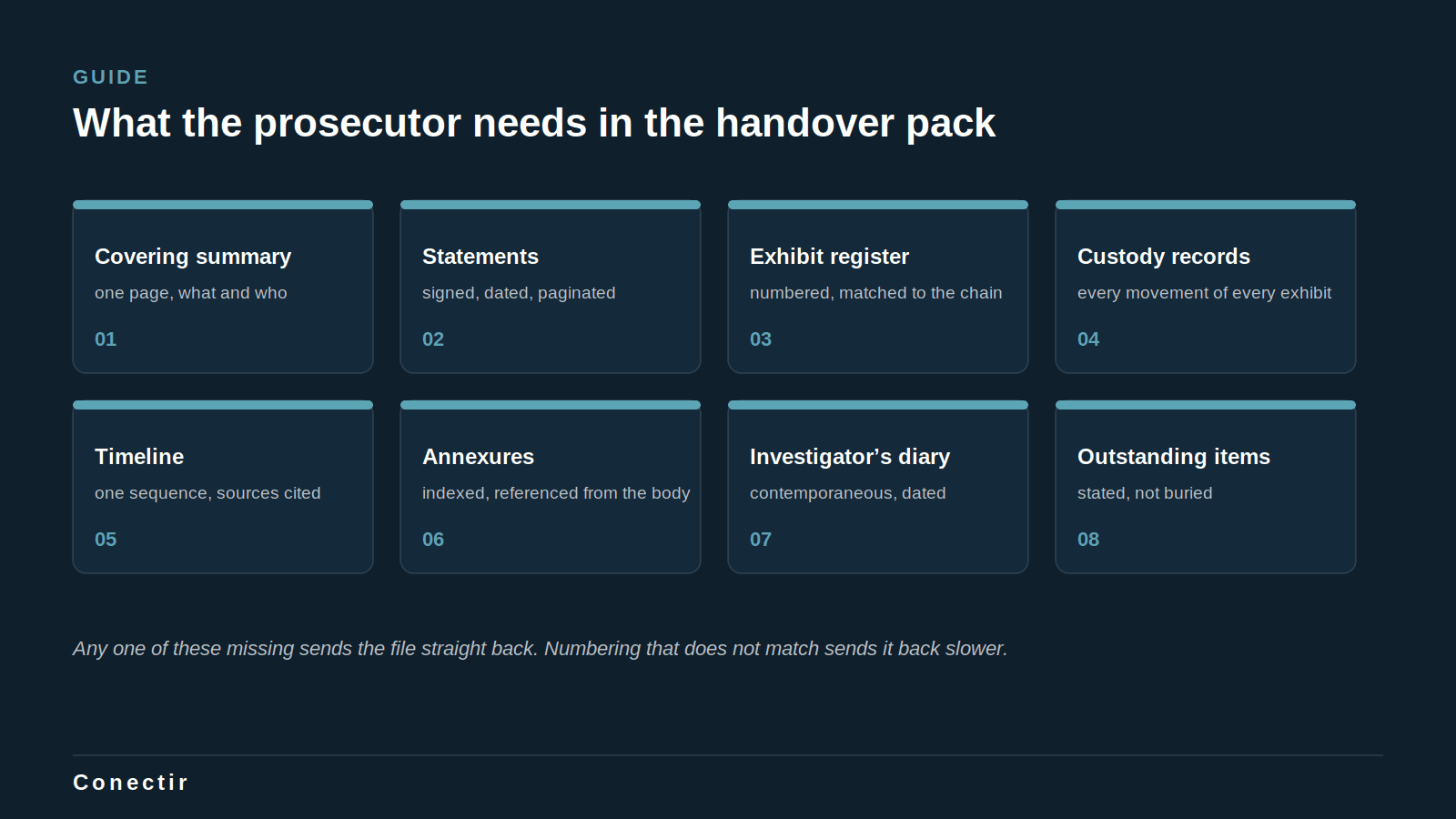
At minimum, a prosecution-ready pack contains: the case theory; a schedule mapping evidence to each element of the offence; an indexed, paginated evidence bundle with chain-of-custody status; the witness statements; a section setting out weaknesses and alternative explanations; flagged disclosure material; and a list of outstanding actions. Presented so a busy, sceptical reader can navigate it fast.
Doing this without it taking a week
Assembling a pack like this, mapping evidence to elements, indexing exhibits, keeping the audit trail straight, separating fact from inference, is exactly the disciplined, structured work that reporting tools are built to speed up. Conectir's reporting assembles findings with their sources attached, keeps facts and inferences separate, and generates a hash-chained audit-log appendix so the evidence's integrity is demonstrable in the pack itself. It helps you produce the defensible structure a prosecutor can trust; the case theory and the judgement stay yours. If you hand cases to prosecutors, see how the reporting tools are set up.
Related guides
See how Conectir’s reporting and court-ready output handles this on a real case — leads to verify, never a verdict.
Frequently asked questions
What goes in a prosecution handover pack?
A clear case theory, a schedule mapping evidence to each element of the offence, an indexed and paginated evidence bundle with chain-of-custody status, the witness statements, an honest account of weaknesses and alternatives, flagged disclosure material, and a list of outstanding actions.
What does "mapping evidence to elements" mean?
Every offence has specific elements that must each be proven. Mapping means showing, element by element, which evidence supports each one, so both the strong points and the gaps become visible before a charging decision is made.
Should I tell the prosecutor about the weaknesses in my case?
Yes. A prosecutor will find them anyway, and flagging them honestly builds trust, lets them prepare, and lets them make an informed decision. Burying weaknesses damages both the case and your credibility when the defence finds them.
What is disclosure and why does it matter at handover?
Disclosure is the prosecution's duty to give the defence material that could undermine the case or assist the accused. Your pack must capture all relevant material, not just the incriminating parts, and flag potential disclosure items, failing to disclose can collapse a case. Rules vary by jurisdiction.
How should the case theory be worded?
Factually and measuredly, what the evidence indicates happened, who, and why it amounts to the offence, not as an emotive assertion of guilt. Overstatement signals poor judgement and undermines trust in the whole pack.