Petty Cash Reconciliation: The Imprest System Explained for Non-Accountants
Petty cash sounds trivial, a tin of small notes for stamps and milk. But it's the loosest, least-watched money in most organisations, and loose money is money that walks. The good news is that keeping petty cash honest is genuinely simple, once you understand one idea: the imprest system. This guide explains it in plain English, with no accounting background assumed.
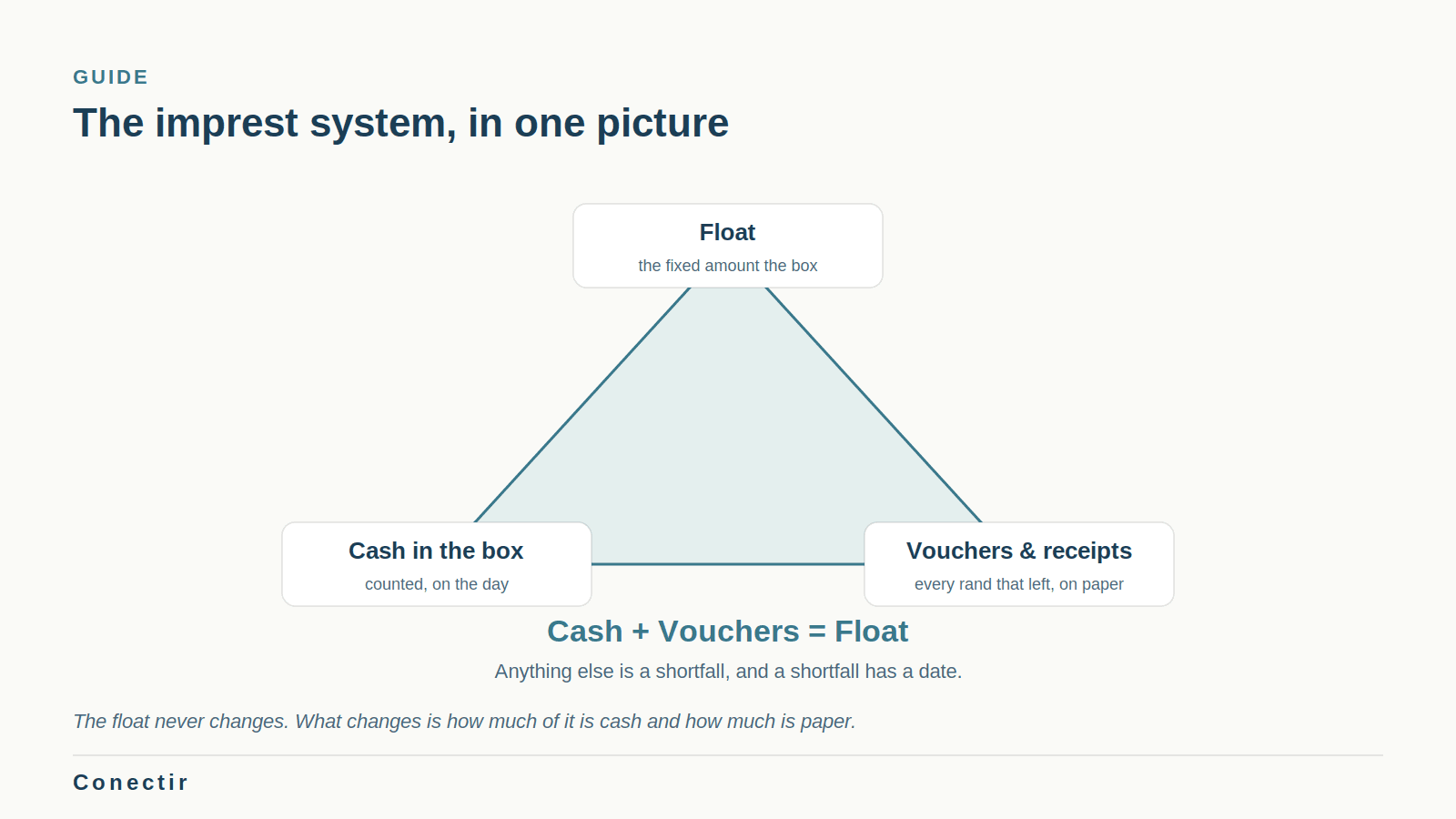
The one idea: a fixed float
An imprest system means the petty cash tin holds a fixed amount, the "float." Say you set it at R2,000 (or £200, or whatever suits). That number never changes. It's the anchor everything else is checked against.
Here's the clever part. At any moment, the tin should contain that fixed amount, made up of cash plus receipts. If you've spent R600 on various bits and kept the receipts, the tin holds R1,400 in cash and R600 in receipts, still R2,000 in total. Spend more, and the cash goes down while the receipts go up, but the two together always come back to R2,000.
When the cash gets low, you hand in the receipts and get reimbursed exactly the value of those receipts, R600 in our example, which tops the cash back up to the full R2,000. The float is restored to its fixed amount, and the cycle starts again.
That's the whole system. And because the total is always supposed to be the same fixed number, checking it is dead easy.
Why the fixed float is so powerful
Compare it to the alternative. If you just top up the tin by random amounts whenever it runs low, there's no fixed number to check against, money can leak out and you'd never know, because there's no "right" total to compare to. The imprest float gives you that fixed number. Any day, unannounced, you can count the tin and it must come to the float. If it doesn't, something needs explaining. That single property, a known total you can check at any time, is what makes petty cash controllable.
How to reconcile petty cash, step by step
Reconciling just means checking the tin adds up to the float. Here's how:
1. Know your float. Confirm the fixed amount the tin is supposed to hold. If nobody can tell you, that's your first problem, you don't have a real imprest system yet.
2. Count the cash. Physically count every note and coin. Write the total down.
3. Total the receipts (vouchers). Add up every receipt and voucher in the tin, the paperwork for money already spent but not yet reimbursed.
4. Add cash + receipts together. This is the moment of truth.
5. Compare to the float.
- If cash + receipts = the float, it balances.
- If it comes to less than the float, there's a shortfall, money is missing and needs explaining.
- If it comes to more, something's off too, usually a records problem, or money added that shouldn't be there.
That's a reconciliation. Anyone can do it in ten minutes.
Do it by surprise
One crucial detail: the count means far more if it's unannounced. If the person who looks after the tin knows you're coming, a small shortfall can be quietly topped up from their own pocket beforehand and put back later. A surprise count catches the tin as it really is. This isn't about treating people as thieves, it's just that a check you can predict is a check that doesn't check anything.
The simple controls that keep petty cash honest
You don't need a finance department. A handful of basic controls do most of the work:
One custodian. One named person is responsible for the tin. Shared responsibility means no responsibility, and no one to ask when it doesn't balance.
A receipt for everything. No receipt, no reimbursement. Every rand out of the tin should have paperwork behind it. "I spent it on something, I just didn't keep the slip" is exactly the gap money disappears through.
Authorisation. Someone other than the custodian approves reimbursements. The person spending the money shouldn't also be the person signing off that it was fine to spend.
A petty cash book. A simple running log: date, what was bought, amount, who authorised it. It turns the tin from a black box into something with a history you can review.
Regular, surprise reconciliation. Count it unannounced, on a schedule only you know. Regular checks catch small problems before they grow.
A sensible float size. Big enough to cover genuine small expenses, small enough that a loss would be limited and noticed. A giant float is just temptation with a lid.
When a reconciliation doesn't balance
A shortfall isn't proof anyone stole anything, so don't leap there. The honest first move is to look for the innocent explanations, because they're common: a genuine expense paid without a receipt kept, a reimbursement claim still sitting in a drawer, a simple arithmetic slip in the cash book, a receipt that fell out. Chase those down first. Ask for the missing paperwork. Redo the sum. Only once you've worked through the innocent possibilities and there's still an unexplained gap do you have something that needs a proper look, and even then, it's a question to answer, not a verdict to pronounce.
Doing the sums without the headache
The imprest system is simple maths, but doing it across months of receipts, totalling vouchers, matching reimbursements, spotting a receipt used twice or a creeping pattern of small shortfalls, gets fiddly and error-prone by hand. Conectir's financial tools read the records, total and categorise transactions, run the reconciliation with every sum shown in plain sight, and flag duplicates and odd entries for you to check. It does the arithmetic and surfaces the anomalies; it never declares anyone a thief. If petty-cash and cashbook checks are part of your work, see how the financial analysis handles a reconciliation.
Related guides
See how Conectir’s financial analysis tools handles this on a real case — leads to verify, never a verdict.
Frequently asked questions
What is the imprest system for petty cash?
A system where the petty cash tin holds a fixed amount (the float). At any time, the cash plus the receipts in the tin should equal that fixed float. When cash runs low, you're reimbursed the exact value of the receipts, restoring the float. Because the total is fixed, it's easy to check.
How do I reconcile petty cash?
Count the cash, total the receipts, add them together, and compare to the fixed float. If they're equal, it balances; less means a shortfall; more means a records problem. It takes about ten minutes.
Why should petty cash counts be a surprise?
Because a custodian who knows a count is coming can temporarily cover a shortfall and replace it afterwards. An unannounced count sees the tin as it really is.
What controls keep petty cash safe?
One named custodian, a receipt for every payment, authorisation by someone other than the custodian, a petty cash book logging every transaction, regular surprise reconciliations, and a float size kept sensibly small.
Does a petty cash shortfall mean someone stole money?
No. Shortfalls are often caused by expenses paid without a kept receipt, unlodged claims or arithmetic errors. Work through the innocent explanations first; only an unexplained gap that survives that is worth investigating, and even then it's a question, not a verdict.