Investigative Interviewing: The Questions That Actually Open a Case Up
The interview is where most of the real information in an investigation comes from, and where most of it gets lost. Ask the wrong way and you'll get a witness who agrees with whatever you suggest, a suspect who shuts down, and an account so contaminated by your own assumptions that it's worthless as evidence. Ask the right way and people tell you things you didn't know to ask about. This guide is about the questions that open a case up rather than close it down.
The goal is accurate information, not a confession
Start from the right aim. A good investigative interview is built to gather complete, accurate, reliable information, not to extract a confession or confirm what you already believe. That distinction changes everything about how you ask. The moment your questions start steering the witness toward your theory, you stop learning and start contaminating. The approaches taught in modern, ethical interviewing frameworks (like the PEACE model used across UK and other policing) all share this foundation: plan the interview, build rapport, get a full free account, then probe, and never bully.
Free recall first: shut up and let them talk
The single most productive thing you can do is get the person to tell the whole story in their own words, uninterrupted, before you ask a single specific question. "Tell me everything that happened that day, from the beginning, in as much detail as you can, even things that seem unimportant."
Then let them. Don't interrupt, don't fill silences, don't finish sentences. People find long pauses uncomfortable and will keep talking to fill them, often with exactly the detail you want. An uninterrupted free account is more complete and less contaminated than anything you'd get by firing questions, because the structure and content come from their memory, not your prompts.
The funnel: open, then narrow
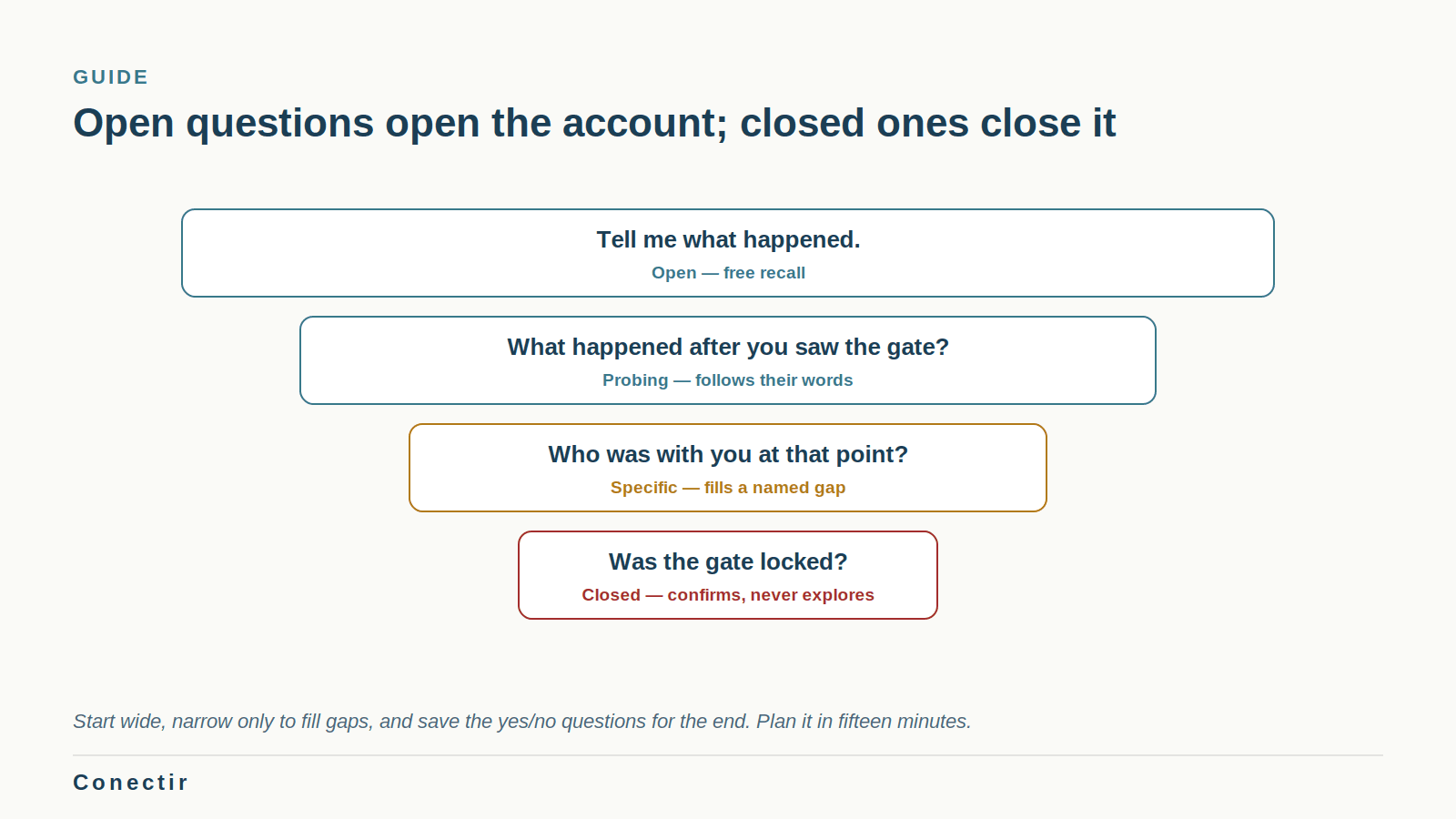
Once you have the free account, go back through it with the funnel technique: start each topic with the most open question you can, and only narrow as needed.
Open questions invite a full answer and impose nothing: "What happened next?" "Tell me about the meeting." "Describe the room." These are your workhorses. They put the burden of production on the witness and give you their words.
Probing questions dig into specifics the free account raised, still without leading: "You mentioned a bag, tell me about the bag." "What did you do after that?"
Closed questions confirm specific facts: "What time was that?" "Was the door locked?" Useful, but only after the open questions have drawn out the account. Lead with closed questions and you get a thin, yes/no account shaped entirely by what you thought to ask.
The order matters as much as the questions. Open to closed, broad to narrow, their account before your specifics.
The questions to avoid
Leading questions plant the answer: "He was angry, wasn't he?" "You saw him take the money, right?" A cooperative or suggestible witness will often just agree, and now the "evidence" is really your suggestion wearing their voice. Rephrase to open: "How would you describe his mood?" "What did you see him do?"
Multiple questions at once ("Where were you, who was with you, and what time was it?") let the witness answer only the easy part and quietly drop the rest. Ask one thing at a time.
Forced-choice questions ("Was it red or blue?") assume it was one of the two. Maybe it was green, or they didn't see. Ask "what colour was it?"
Opinion and jargon questions confuse or invite speculation. Ask about what they observed, in plain language.
Use their words, not yours
When you probe, echo the witness's own vocabulary rather than translating it into yours. If they said "the guy," ask about "the guy," not "the suspect." If you rename things, you subtly reshape their memory and you risk importing detail they never gave. Their words are the evidence; keep them intact.
This is also how you catch the gold. Note the words they choose, the things they mention unprompted, the places they go vague. Those are your probing targets, and, later, the points to test against the other statements and the timeline.
Plan before, listen during, record after
Plan. Before the interview, know what you need to establish, what evidence you have, and what this person is likely able to speak to. A planned interview covers the ground; an unplanned one wanders and forgets the key question.
Listen. During, your job is mostly to listen and to ask the minimum needed to keep the account flowing and complete. If you're talking more than the witness, you're doing it wrong.
Record. After, capture the account accurately and contemporaneously. Where you can, get the account in the witness's own writing or recorded, so the words are theirs and not your paraphrase.
Handling reluctance and evasion, without pressure
Not everyone wants to talk, and some will be evasive. The temptation is to push harder; the professional move is to stay calm, keep building rapport, and keep using open questions. Pressure produces compliance, and compliance produces unreliable answers, people say what makes the pressure stop, not what's true. If an account is evasive, note where it goes evasive (that's a lead in itself) and come back to it gently from another angle rather than confronting head-on. And know the legal limits and cautions that apply in your jurisdiction, an interview conducted improperly can render everything in it useless.
Turn the interview into the next questions
An interview rarely closes a case; it opens the next round. As you review the account, mark the points that need checking against other statements, the claims that need documentary support, and the new questions the answers raised. The best interviews generate a sharper, shorter list of things you still need to find out. That list, not a confession, is the real product.
Doing this with a plan you can lean on
Knowing what to ask a particular witness, given what the statements already say and where the gaps and contradictions are, is where interview planning gets hard, especially under time pressure. Conectir's Advisor is built to help here: it reasons over the case as it stands and suggests the follow-up questions and next steps the evidence points to, so you go into the interview with a plan rather than improvising. It suggests lines of inquiry; the interview, and the judgement, stay yours. If planning interviews is part of your work, see how the Advisor supports it.
Related guides
See how Conectir’s AI Advisor handles this on a real case — leads to verify, never a verdict.
Frequently asked questions
What is the best type of question in an investigative interview?
Open questions, "what happened next?", "describe the room", because they let the witness give a full account in their own words without being steered. Use closed questions only afterwards, to confirm specific facts.
What is free recall and why does it matter?
Free recall is letting the witness tell the whole story uninterrupted before you ask anything specific. It produces a more complete and less contaminated account, because the content comes from their memory rather than your prompts.
Why are leading questions a problem?
Because they plant the answer ("he was angry, wasn't he?") and suggestible or cooperative witnesses often just agree, turning your suggestion into apparent evidence. Rephrase them as open questions instead.
What is the funnel technique?
Starting each topic with the most open question possible and narrowing only as needed, open, then probing, then closed. It draws out the witness's own account before you introduce specifics.
How should I handle a reluctant or evasive witness?
Stay calm, keep building rapport, and keep asking open questions rather than applying pressure, which produces unreliable answers. Note where the account turns evasive as a lead, and observe the legal cautions that apply in your jurisdiction.