How to Spot Contradictions in Witness Statements
Contradictions hide in plain sight. Read two statements casually and they seem to broadly agree; read them properly and the clashes surface. The difference is method. This guide gives you a repeatable way to find the contradictions that matter, and, just as importantly, to ignore the ones that don't.
First, know what you're actually hunting
A "contradiction" isn't just any difference between accounts. Two witnesses will always differ, because they saw different things from different places and remember differently. Most of those differences are noise. A contradiction worth spotting is one where the accounts cannot comfortably both be true, on a point that matters to the case, from witnesses who were positioned to know.
Hold those three filters in mind, incompatibility, relevance, and vantage, and you'll stop chasing every trivial mismatch and start finding the real ones.
The method: convert prose into events, then compare
You can't reliably spot contradictions by reading two blocks of text back and forth. Your eye slides over them. The reliable method is to break each statement down and line the pieces up.
Step 1, Extract the claims. Go through each statement and pull out its concrete, checkable claims: who did what, where, when, with whom. Turn flowing prose into a list of discrete statements of fact.
Step 2, Anchor each claim. Tag each claim with its time, place and people. Note how firm each anchor is, an exact time versus a rough one, a specific place versus a vague one.
Step 3, Line up matching claims. Put claims about the same event, person or moment side by side across the statements. This is where contradictions become visible: two claims about the same thing, sitting next to each other, either agree or they don't.
Step 4, Interrogate each clash. For every pair that doesn't agree, run the four questions below.
The four questions that surface real contradictions
1. Can both accounts actually be true at once? If yes, it's not a contradiction, it's two compatible observations. "I saw him in the corridor" and "I saw him in the car park" can both be true at different times. Only if they're locked to the same moment do they clash. Be precise about this; most apparent contradictions dissolve here.
2. Were both witnesses positioned to know? A clash between two people who both had a clear view is serious. A clash between someone who was there and someone who's guessing, or repeating what they heard, isn't a real conflict, one side simply doesn't know. Weight the accounts by vantage before you weight the contradiction.
3. Does the point matter? A contradiction about the colour of someone's shirt is usually irrelevant; a contradiction about who was holding the cash is not. Spend your attention on clashes that touch the actual question you're investigating.
4. Is there an innocent explanation, and does the clash survive it? For every real clash, name the benign reading, misremembering, rounding, a different vantage, honest confusion. If the innocent explanation fully accounts for the difference, downgrade it. If the accounts are specific, both witnesses knew, the point matters, and no innocent explanation fits, that's a contradiction worth chasing hard.
The contradiction that's hardest to see
The clashes above are between two things said. The sneakiest contradiction is between something said and something not said, where one account includes a detail and another, which should mention it, is silent. The classic is an alibi: a suspect says he was with a named person, but that person's own account never places him there. Nothing is directly denied, so it doesn't jump out. You only catch it by noticing an expected claim is missing, which is why laying the accounts out event by event, and seeing the empty cells, matters so much.
Don't forget contradictions within a single statement
You don't always need two witnesses. A single statement can contradict itself, a detail early on that can't sit with a detail later, a timeline that doesn't close, a person who's in two places. Internal contradictions are often more telling than cross-witness ones, because there's no "different vantage point" to explain them away. Read each statement once for internal consistency before you compare it to anything else.
Turn contradictions into questions, not accusations
Spotting a contradiction is the start, not the end. A contradiction is a question you now need answered, and it points you at exactly who to ask and what. "You said the truck came after lunch; your colleague said 2 o'clock, talk me through that part of the afternoon again." You resolve contradictions through follow-up and through other evidence, not by declaring, on the strength of the clash alone, that someone lied. The clash tells you where to dig; the digging tells you what it means.
Keep a record of what you found and how
If your findings are ever challenged, "I noticed some inconsistencies" is weak. Keep your working: the claim lists, the side-by-side comparison, each clash you flagged, the innocent explanation you weighed, and the follow-up it generated. That record shows a careful, fair method rather than a hunch, and it's the difference between a finding that stands and one that gets waved away.
Doing this reliably across several statements
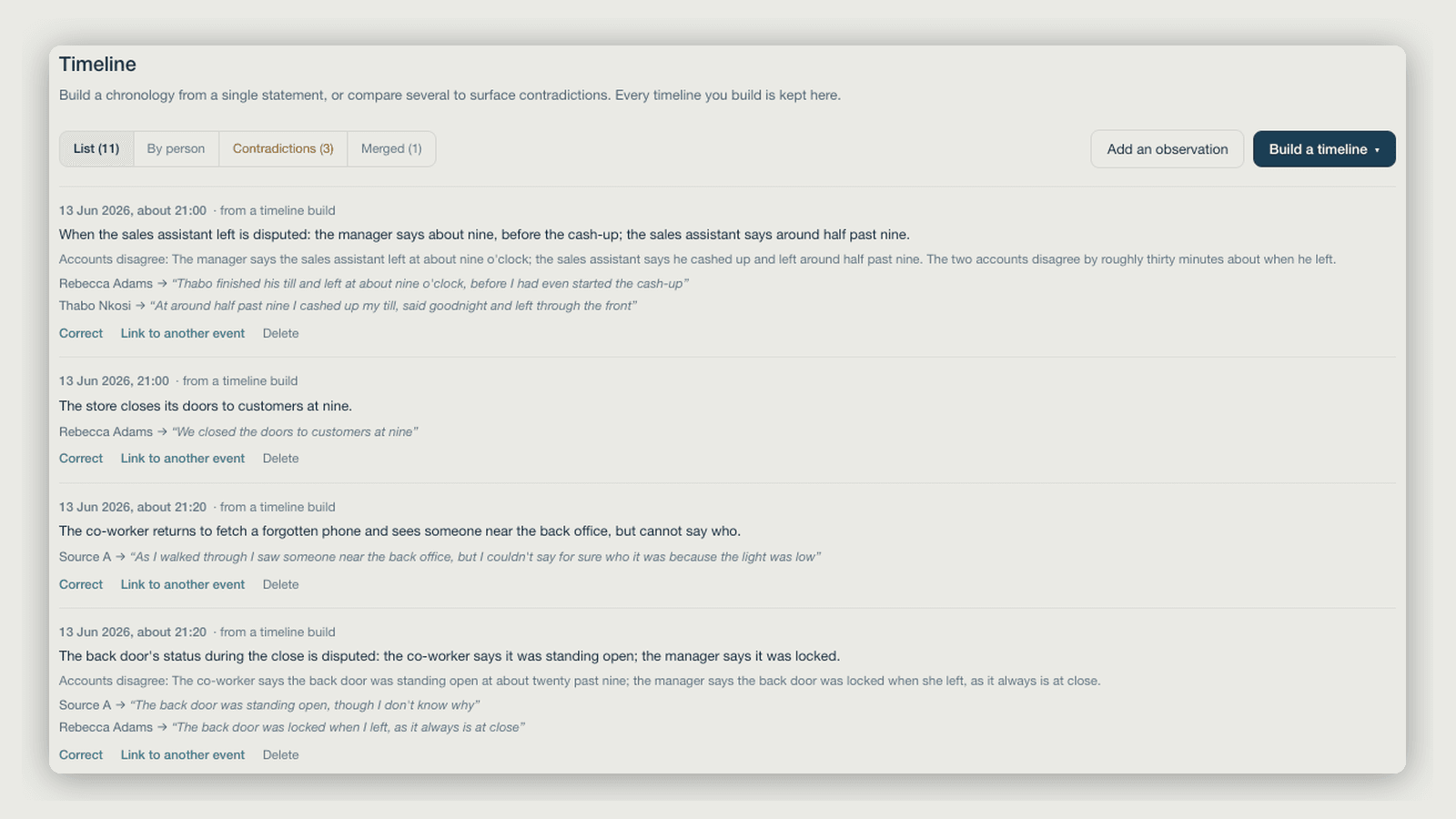
The extract-anchor-compare method is sound, but doing it by hand across three, four or five statements is slow and error-prone, and the contradiction you miss is usually the one buried in the account you skimmed. Conectir's timeline builder does exactly this mechanical work: it extracts the time-anchored events from each statement, lines them up on one timeline, and flags the clashes as hard or soft contradictions, marks single-source claims, and catches uncorroborated-presence gaps, with the source quote on every line so you can judge it. It finds the clashes; you decide what they mean. If comparing statements is regular work, see how the timeline tool handles it.
Related guides
See how Conectir’s timeline builder handles this on a real case — leads to verify, never a verdict.
Frequently asked questions
How do I find contradictions in witness statements?
Break each statement into concrete claims, anchor each to a time, place and people, line up claims about the same event across statements, and interrogate every pair that doesn't agree. Reading two statements back and forth is unreliable; converting them into comparable events is not.
What counts as a real contradiction?
One where the accounts cannot both be true at the same moment, on a point that matters to the case, from witnesses who were positioned to know, and where no innocent explanation fully accounts for the difference.
Does a contradiction mean a witness lied?
No. Most differences come from memory, rounding, or a different vantage point. A contradiction is a question to resolve through follow-up and other evidence, not proof of deception on its own.
What's a contradiction of omission?
When one account includes an important detail and another, which should mention it, stays silent, most notably an alibi that the alibi-giver's own witness never confirms. It's easy to miss because nothing is directly denied.
Can a single statement contradict itself?
Yes, internal contradictions, where an early detail can't sit with a later one, are common and often more telling than cross-witness clashes, since there's no difference of vantage to explain them.