The Contemporaneous Diary: Why Cases Die Without One
Ask any experienced investigator what they wish they'd done more consistently, and a lot of them will say the same thing: kept better notes. The contemporaneous diary is the least glamorous tool in the kit and one of the most important. Cases don't usually die on a dramatic technicality. They die quietly, months later, when someone asks "how do you know that?" and the honest answer is "I remember it that way." This guide is about never having to give that answer.
What "contemporaneous" actually means
Contemporaneous means made at the time, or as close to it as practically possible. A note written in the moment, or the same day, is contemporaneous. A note reconstructed three weeks later from memory is not, and everyone in the room will know the difference.
The reason the timing matters so much is human memory. Memory is not a recording; it is a reconstruction, and it rewrites itself every time you recall something. Details fade, order scrambles, and, most dangerously, memory quietly updates itself with things you learned later, so you become genuinely convinced you knew at the time something you only found out afterwards. A contemporaneous note freezes what you actually knew and did at that moment, before hindsight gets its hands on it.
Why it decides cases
A contemporaneous diary does several jobs at once, and each of them can be the thing that saves a case:
It refreshes your memory, admissibly. When you're questioned about events from a year ago, you're often allowed to refer to notes you made at the time to refresh your memory. Without them, you're relying on raw recollection, which is both unreliable and easy to attack.
It proves what you did and when. Chain of custody, the sequence of your investigation, when you received a piece of evidence, when you interviewed someone, the diary is the record that ties it all together and shows you followed a proper process.
It defends your integrity. If you're accused of fabricating, backfilling, or doing things out of order, a genuine contemporaneous record is your best answer. It shows a real-time trail that would be very hard to fake convincingly after the fact.
It catches the detail you'd otherwise lose. The small observation that seems irrelevant on Tuesday can be the hinge of the case in six months. Written down, it survives. Trusted to memory, it's gone.
What to record
You don't need to write an essay. You need a consistent, honest, time-stamped log. For each entry, capture:
- Date and time the entry is made (and the date/time of the event if different).
- What you did, the action, observation, conversation or decision.
- Who was involved, names, roles.
- Why, the reasoning behind a decision, briefly. Future-you will not remember why you chose to do X instead of Y.
- What resulted, what you found, what was handed over, what was agreed.
Record decisions and reasoning, not just events. "Decided not to interview the cleaner yet because…" is gold when someone later asks why you didn't. The why is often more valuable than the what.
The rules that keep a diary credible
A diary is only worth having if it's the kind a court or panel will trust. Four habits do that:
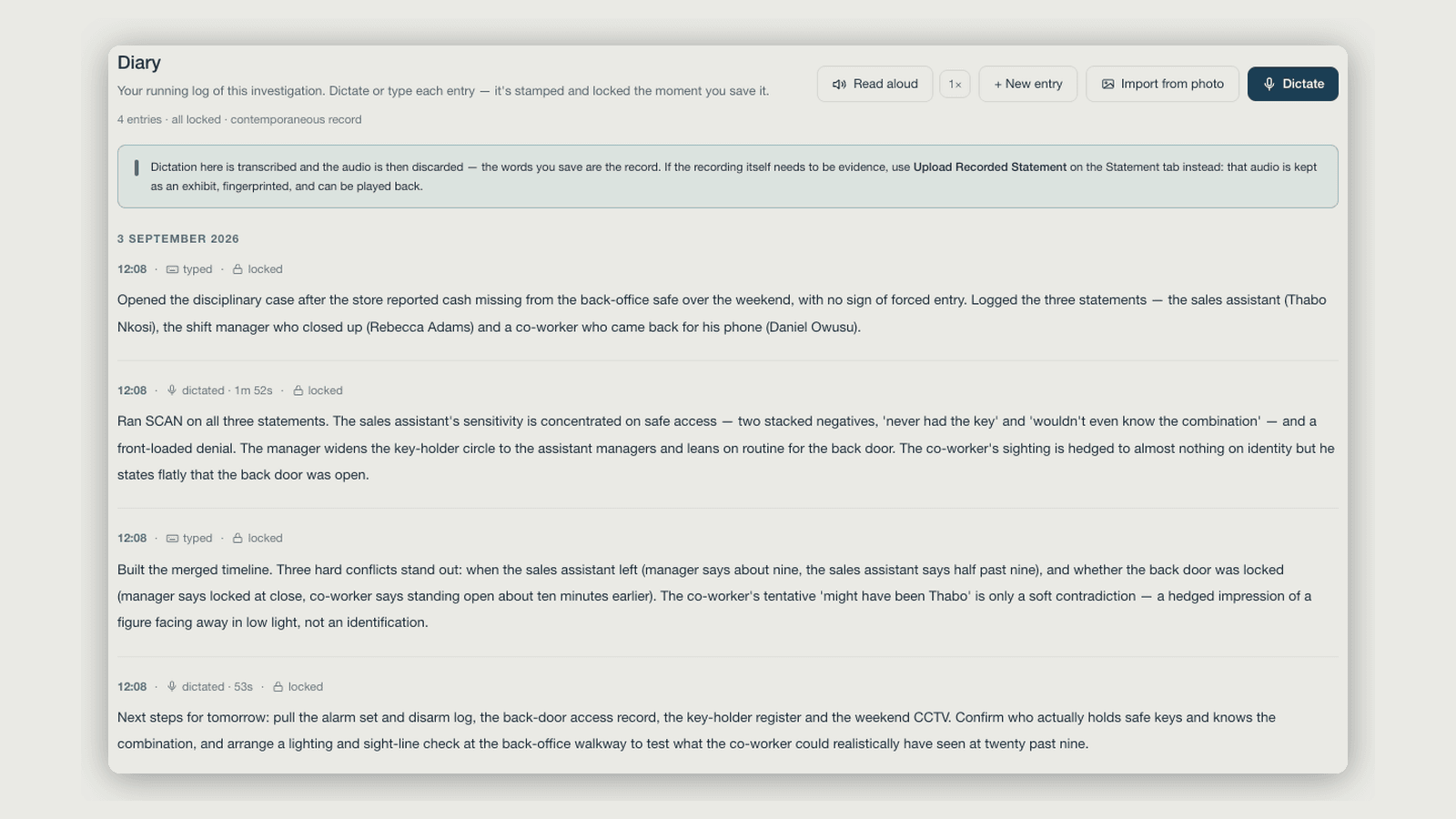
Write in ink, or in a system that timestamps and locks entries. The whole value is that the record is fixed. A notebook you could rewrite, or a document with no reliable dates, defeats the purpose.
Never erase or delete, strike through and initial. If you make a mistake, put a single line through it so it's still readable, write the correction, and initial it. A clean erasure looks like a cover-up; a visible correction looks honest, because it is.
Don't backfill and pretend. If you genuinely have to record something after the fact, say so and date it honestly: "Note made 20 May recording a conversation of 14 May." An honest late note is worth something; a late note dressed up as contemporaneous, once exposed, destroys your credibility on everything.
Keep it factual and neutral. The diary is not the place for editorialising or speculation about guilt. Record what happened. Save the analysis for the report.
The common failures
- Starting late. Beginning the diary only once a matter "gets serious", by which point the crucial early period is undocumented.
- Gaps. Recording the exciting days and skipping the quiet ones, so the record looks selective.
- Vagueness. "Spoke to a few people" instead of who, when and what was said.
- Recording conclusions, not observations. Writing "the subject was obviously lying" instead of what the subject actually said and did.
- Losing it. A brilliant diary in a notebook that goes missing is no diary at all. Storage matters as much as the writing.
It's a habit, not a project
The reason people don't keep good contemporaneous notes isn't that they don't understand the value, it's that in the moment there's always something more urgent. The fix is to make it frictionless and automatic: a fixed place to write, a habit of logging the action the moment it's done rather than "later," and a format so simple you never have to think about it. A diary you actually keep beats a perfect system you abandon by week two.
Doing this without a shoebox of notebooks
The practical problem with contemporaneous notes is discipline and storage: loose notebooks get lost, and reconstructing a timeline from them is painful. Conectir keeps a running, time-stamped record of the work done on a case and produces a hash-chained audit trail for the report, so the "when and by whom" is captured as you go rather than rebuilt from memory. It makes the contemporaneous record a by-product of doing the work. If a defensible trail matters to your cases, see how the reporting and audit tools handle it.
Related guides
See how Conectir’s reporting and court-ready output handles this on a real case — leads to verify, never a verdict.
Frequently asked questions
What does "contemporaneous" mean in investigation notes?
Made at the time of the event, or as close to it as practically possible. A note written in the moment or the same day is contemporaneous; one reconstructed weeks later from memory is not, and carries far less weight.
Why is a contemporaneous diary so important?
Because memory is unreliable and quietly rewrites itself with hindsight. A note made at the time freezes what you actually knew and did, lets you refresh your memory admissibly later, proves your process, and defends you against claims of fabrication.
What should I record in an investigation diary?
The date and time, what you did, who was involved, why you made the decisions you made, and what resulted. Recording your reasoning, not just events, is often the most valuable part.
Can I correct a mistake in a contemporaneous diary?
Yes, but never erase or delete. Strike through the error with a single line so it stays readable, write the correction, and initial it. Visible corrections look honest; clean erasures look like cover-ups.
Is it too late to start a diary once a case is underway?
Start immediately regardless, a diary from now on is far better than none. But record any earlier events honestly as late notes, dated when you actually wrote them, rather than pretending they were contemporaneous.