How to Compare Two Witness Statements (and What to Look For First)
Two people watched the same event. Their written accounts should broadly agree, but they never do, not completely. Some of the differences are meaningless. One or two of them might be the whole case. The skill is telling those apart, and doing it in a way you can defend later if a lawyer pulls the two statements out side by side.
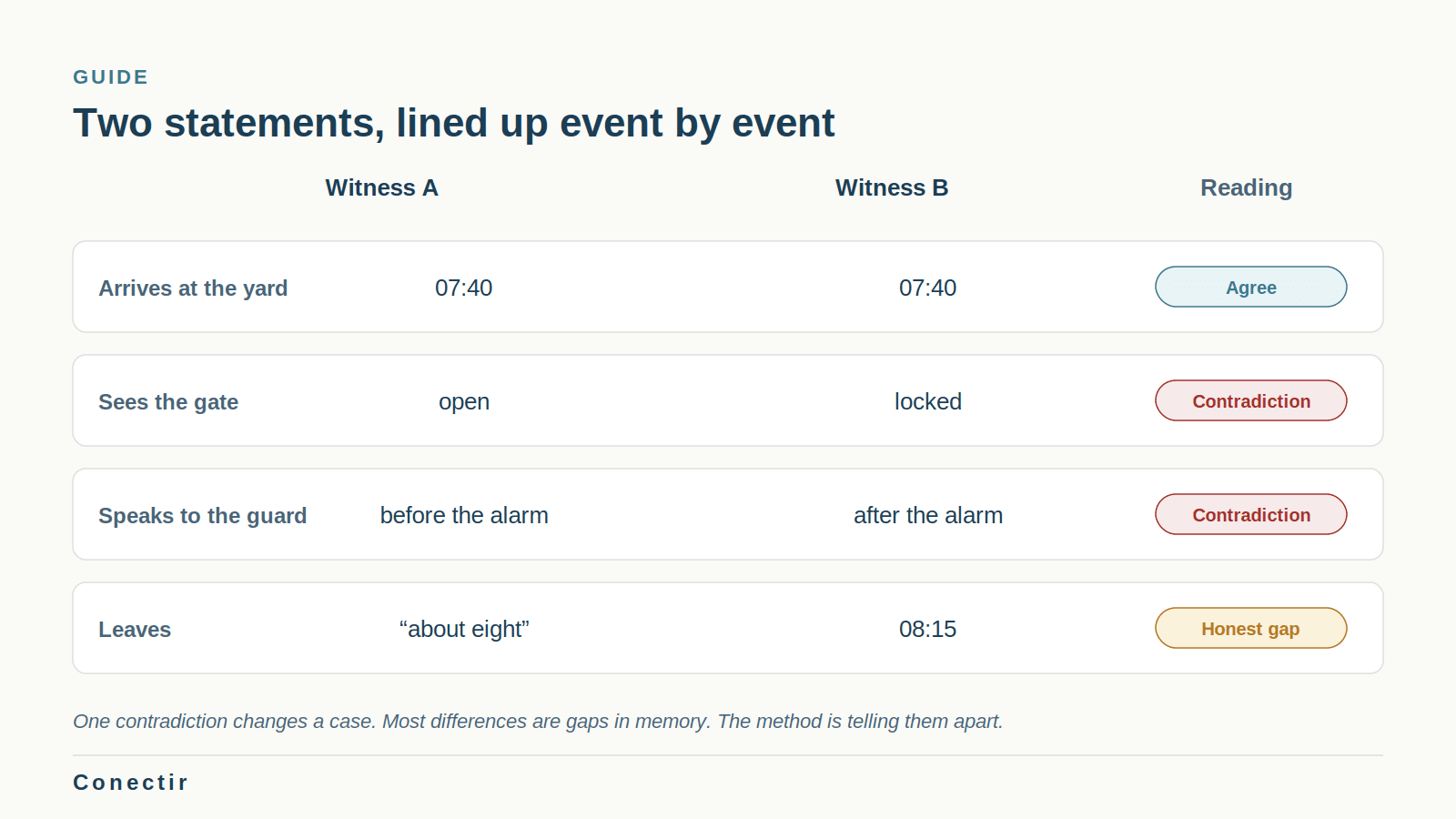
This guide sets out a repeatable method for comparing two witness statements. It works with paper, a highlighter and a notepad; it works faster with software; and it works the same way whether you are looking at a workplace theft, an insurance claim, or a criminal matter.
Read each statement once, on its own, before you compare anything
The most common mistake is to read both statements at the same time, hunting for differences. Do the opposite. Read the first statement start to finish without a pen in your hand. Then read the second the same way. You are not looking for contradictions yet, you are letting each person tell their story in their own order.
Why this matters: every account has an internal logic. A witness moves through time, place and people in a sequence that makes sense to them. If you start cross-referencing on the first read, you lose that sequence and you start imposing your own theory of what happened. Read each account whole, and you will notice its shape, where it slows down, where it rushes, where it goes quiet.
Break each statement into time-anchored events
Now go back with a pen. Pull out every event that is anchored to a time, a place or a named person. Write each one as a short line: 06:30, opened the warehouse, Susan. "After lunch", truck arrived, David.
Mark how precise each time is. "At 14:00" is exact. "Around 2" is approximate. "After lunch" is relative, it only means something once you know when lunch was. "That afternoon" is vaguer still. You are not just recording what happened; you are recording how firmly each witness has pinned it down. A soft time on one side and a hard time on the other is not automatically a contradiction, the soft one simply cannot carry much weight.
Do this for both statements. You now have two lists of events instead of two blocks of prose, and lists are far easier to line up.
Merge the two lists into one timeline
Lay the events out in a single chronological order, tagging each one with who said it. Where both witnesses describe the same event, put them on the same line. This is the moment the comparison actually happens, and four things fall out of it:
Corroboration. Both witnesses independently describe the same event at the same time. This is the strongest thing you can find, but only if the accounts are genuinely independent. Two people who wrote their statements together, or after a long chat, are not two sources. Corroboration is worth checking for contamination before you lean on it.
Hard contradiction. The two accounts cannot both be true. One says the manager left at 17:00; the other says the manager was still there at 18:00. That is a clash worth chasing.
Soft contradiction. The accounts differ but could still both be roughly right, "around 2" versus "about half past two." Honest witnesses disagree about small times constantly. Note it, but do not build your case on it.
Single-source events. Only one witness mentions something. That is not a lie, most of what any one person sees is unique to them. But a single-source event that matters to the case (a person at a back gate, a bag being moved) is a lead: something to put to the other witness and to other evidence.
Separate the contradictions that matter from the ones that do not
Here is the discipline that keeps you honest. Every difference you find has at least one innocent explanation, and you should write it down before you get excited.
People forget. People compress time. People round to the nearest half-hour. Two people standing three metres apart genuinely see different things because their view was different. Memory reorders events, especially under stress. None of that is deception, it is how normal recollection works.
So for every contradiction, ask: what is the innocent version of this? If the innocent version is plausible, the contradiction is a question, not a finding. If you genuinely cannot construct an innocent version, the two accounts are specific, both witnesses were well-placed to know, and they still clash head-on, then you have something worth serious follow-up.
This is the leads-not-verdicts rule, and it protects you. An investigator who flags every difference as a lie gets torn apart in cross-examination. An investigator who can say "I noted the difference, here is the innocent explanation I considered, and here is why I still thought it needed a question" looks careful and fair.
Watch for the contradiction of omission
The hardest clash to spot is not two accounts saying different things, it is one account saying something and the other staying silent where you would expect it to speak. A suspect says he was at a friend's house "with my brother." The brother's own account of that evening names three other people and never mentions the suspect. Nothing is directly contradicted, but the alibi is not supported by the person it depends on. That gap is often more telling than a head-on clash, and it only shows up when you have both accounts laid out event by event.
Turn each finding into a follow-up question
A comparison is only useful if it changes what you do next. For each hard contradiction and each significant single-source event, write the question it raises, the thing you now need to ask this witness, that witness, or a third source. "You said the truck arrived after lunch; David says 14:00, can you fix that more tightly? What were you doing just before?" The output of a good comparison is not a verdict. It is a shorter, sharper list of things you still need to find out.
Keep a record of how you did it
If this comparison ever ends up in front of a disciplinary panel, a lawyer or a court, you will be asked how you reached your conclusions. Keep the working: the two event lists, the merged timeline, the contradictions you flagged, and the innocent explanations you weighed. "I read both statements and formed a view" is weak. "Here is my event-by-event reconciliation, here is what I flagged and why, here is what I ruled out" is strong.
Doing this at scale
The method above is entirely manual and it works. The friction is time: building two event lists and merging them by hand takes an hour per pair of statements, and it gets exponentially harder with three, four or five accounts of the same event.
This is the specific job Conectir's timeline builder does, it takes multiple statements, extracts the time-anchored events from each, merges them into one chronological view, and flags corroborations, hard and soft contradictions, single-source events and coverage gaps, with the source quote attached to every line. It surfaces the differences for you to judge; it never tells you who is lying. If comparing statements is a regular part of your work, it is worth seeing how the timeline tool handles a multi-statement case.
Related guides
See how Conectir’s timeline builder handles this on a real case — leads to verify, never a verdict.
Frequently asked questions
What should I look at first when comparing two witness statements?
Read each statement on its own, all the way through, before comparing. Then break each into time-anchored events and merge them into one timeline. The differences fall out of the merged view far more reliably than from reading both at once.
Is a contradiction between two witnesses proof that someone is lying?
No. Most differences between honest accounts come from forgetting, compressing time, rounding, or simply having a different vantage point. Treat every contradiction as a question with an innocent explanation to rule out first, not as proof of deception.
How do I compare more than two statements?
The same method scales, but the manual effort grows quickly. Build an event list per statement and merge all of them onto a single timeline, tagging each event with its source. With four or five accounts, software that does the merge automatically saves hours.
What is a "single-source" event and does it matter?
It is an event only one witness mentions. That is normal, most of what a person sees is unique to them, but a single-source event that is important to the case is a lead worth putting to the other witnesses and checking against other evidence.
How do I record a statement comparison so it holds up later?
Keep your working: the event lists, the merged timeline, each contradiction you flagged, and the innocent explanation you considered for it. Being able to show your method and your reasoning is far stronger than presenting a bare conclusion.