Chain of Custody for Digital Evidence (Photos, Phones, Exports)
A document can be sealed in a bag and signed across the flap. A digital file can't, it can be copied, edited and re-saved without leaving a mark a human eye would notice. That's what makes digital evidence both powerful and fragile: powerful because it often carries precise timestamps and metadata, fragile because the other side can always ask "how do we know this file wasn't changed?" This guide is about being able to answer that question, every time.
Why digital evidence needs its own rules
The core chain-of-custody principles, record what it is, where it came from, who handled it, and when, apply to digital evidence exactly as they do to physical. But digital evidence adds three problems physical evidence doesn't have:
- It's invisibly alterable. Opening a file can change it. Editing leaves no physical trace. A screenshot is trivially faked.
- It's easily copied, which is good (you can preserve an original and work on a copy) but also means you must be crystal clear which is the authentic original.
- It carries hidden data, metadata, that can be evidence in itself, and that careless handling can destroy.
So the digital chain needs an extra tool that physical evidence doesn't: a way to prove a file is unchanged. That tool is hashing.
Hashing: the digital seal
A hash is a mathematical fingerprint of a file. You run the file through a hashing algorithm (common ones are SHA-256) and get back a fixed string of characters unique to that exact file. Change one byte, a single pixel, one character, the smallest edit, and the hash comes out completely different.
That property is what makes hashing the digital equivalent of sealing and signing an evidence bag. The procedure:
- The moment you acquire a digital item, calculate its hash and record it in your custody log alongside the file's details.
- From then on, that recorded hash is your reference. Any time integrity is questioned, including months later in a hearing, you re-hash the file and compare.
- If the hash matches, the file is provably identical to the one you acquired. If it differs, the file has changed, and you'll know.
Record the algorithm you used and the exact hash value. A hash with no record of when it was taken proves nothing; a hash recorded at acquisition proves everything.
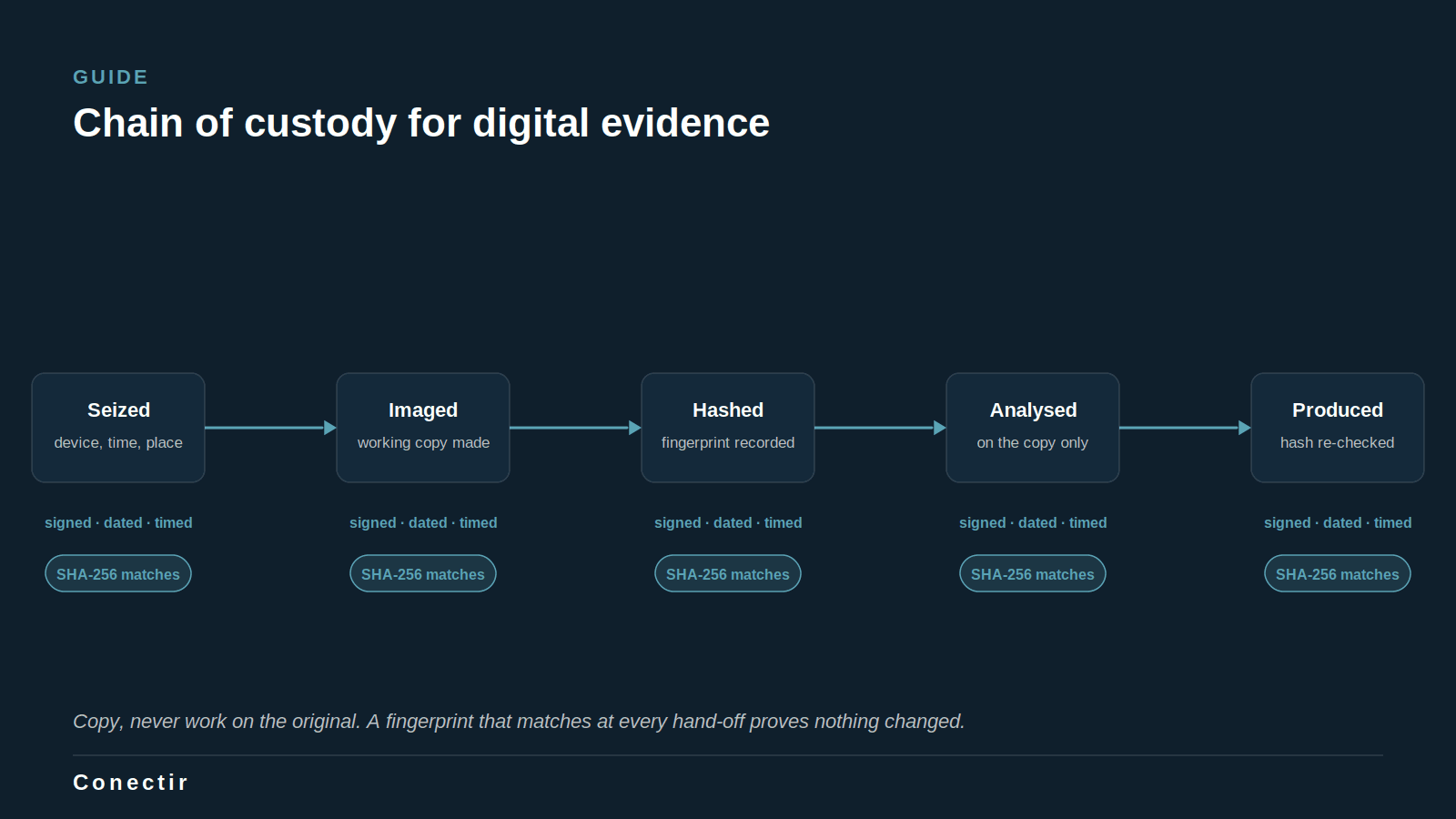
Preserve the original, work on a copy, always
Never work on the only copy of digital evidence, and never work on the authentic original if you can avoid it. The safe pattern:
- Acquire the item and immediately make a preservation copy.
- Hash both, confirm they match, and lock the original away in access-controlled storage.
- Do all your examination, annotation and analysis on a working copy.
This way, whatever happens during your analysis, an untouched, hash-verified original always exists to fall back to. If someone alleges you altered the evidence, you produce the original, re-hash it, show it matches the value you recorded at acquisition, and the allegation collapses.
Handle metadata like the evidence it is
Digital files carry metadata, data about the data, and it's often the most valuable part. A photo's EXIF data can hold the date, time, camera and sometimes GPS location it was taken. A document holds created and modified dates and sometimes the author. An email holds headers showing its true route.
Two rules follow. First, preserve metadata: copy files in ways that keep it intact (a careless copy, a screenshot, or re-saving through some apps can strip or overwrite it). Second, don't trust it blindly: metadata can be wrong (a camera with the clock unset), or deliberately faked. Treat metadata as evidence to be corroborated, not as automatically true, the same leads-not-verdicts discipline you apply everywhere.
The specific traps with common evidence types
Photos. A photo sent over a messaging app is usually re-compressed and stripped of its original metadata, it's a copy of a copy. Where authenticity matters, get the original file from the source device, not the version that came through chat. Record where you obtained it.
Phone data. Phones are dense evidence and legally sensitive. Note that how you obtain phone data matters enormously for admissibility and for privacy law, consent, authority, and proper acquisition all bear on whether it can be used at all. If a matter is serious, phone extraction may be a job for a specialist with the right tools and legal cover, not a manual scroll-through.
Exports and screenshots. An export from a system (a transaction list, a chat log) is only as trustworthy as the process that produced it. Record who ran the export, from what system, when, and hash the result. A screenshot is the weakest form, easy to fake and lacking metadata, so treat it as a pointer to better evidence, not the evidence itself.
Document the digital chain
Your custody log for a digital item should capture, at minimum: a unique reference and description, the source device or system, who acquired it and when, how it was acquired, the hash value and algorithm, where the original is stored, and a movement log of every access. Never delete entries, the history is what proves integrity.
Know your legal boundaries
Digital evidence sits on top of privacy and data-protection law, and the rules vary by jurisdiction. Accessing someone's device or accounts without proper authority can make the evidence inadmissible and expose you to legal liability. Before acquiring digital evidence, be clear about the authority you're relying on, consent, employment policy, a legal instrument, and record it. Getting a smoking-gun file the wrong way can lose you both the file and the case.
Doing this without losing the trail
The practical difficulty with digital chain of custody isn't understanding hashing, it's doing the record-keeping consistently, and being able to show, at report time, that everything you relied on is intact. Conectir stores evidence in a private, access-controlled store and produces a hash-chained audit trail for the report, so integrity is demonstrable from acquisition through to the finished document rather than reconstructed after the fact. It builds the verifiable trail as you work. If demonstrating digital evidence integrity matters to your cases, see how the evidence and reporting tools handle it.
Related guides
See how Conectir’s reporting and court-ready output handles this on a real case — leads to verify, never a verdict.
Frequently asked questions
What is a hash and why is it used for digital evidence?
A hash is a unique fingerprint of a file produced by an algorithm like SHA-256. Any change to the file changes the hash completely, so recording a file's hash when you acquire it lets you later prove the file is unaltered, the digital equivalent of a sealed evidence bag.
Should I work on the original digital file?
No. Make a preservation copy, hash both to confirm they match, lock the original away, and do all your work on a working copy. That way a hash-verified untouched original always exists to defeat any claim of alteration.
Why does metadata matter in digital evidence?
Metadata, like a photo's date, time and GPS, or a document's author and dates, is often valuable evidence in itself. Preserve it by copying files carefully, but corroborate it rather than trusting it blindly, since it can be wrong or faked.
Is a screenshot good digital evidence?
It's the weakest form, easy to fake and lacking metadata. Treat a screenshot as a pointer to better evidence (the original file or a proper export), not as reliable evidence on its own.
Can I get digital evidence from someone's phone or accounts myself?
Only with proper authority. Accessing devices or accounts without consent or legal basis can make the evidence inadmissible and expose you to liability, and rules vary by jurisdiction. Record the authority you rely on, and use a specialist for serious phone extraction.