Bank Statement Analysis for Investigators: The Bank Deposits Method, Plainly
When someone's spending or lifestyle doesn't match their declared income, bank statements are often where the truth hides in plain sight. The bank deposits method is the forensic technique for reading them. It is used by tax authorities, fraud investigators and forensic accountants the world over, and the logic is simple enough to explain on the back of an envelope. This guide sets it out plainly.
The idea in one sentence
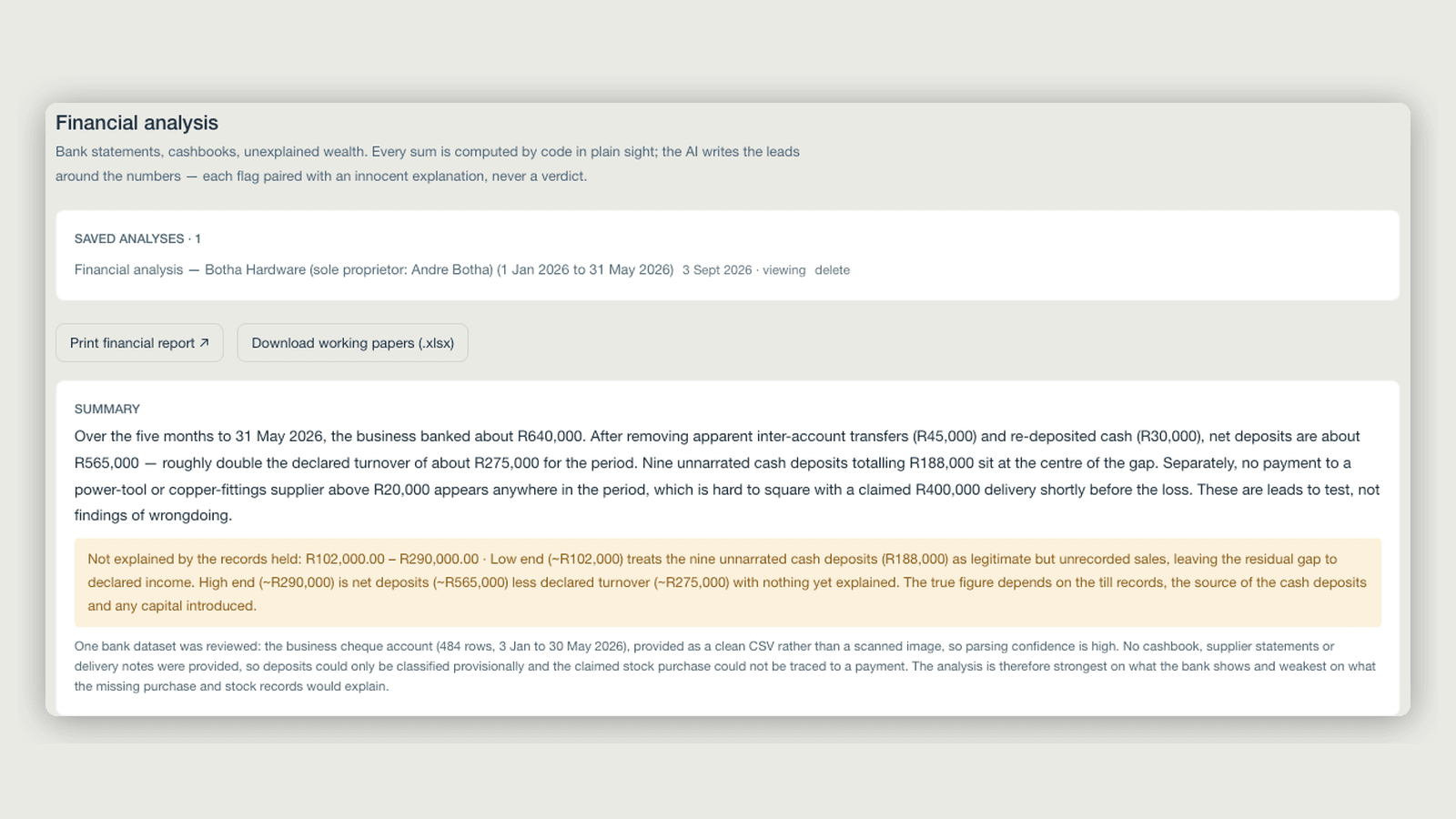
If you add up all the money someone put into their accounts over a period, strip out the deposits that are not income, and adjust for cash they spent without banking it, what's left is a fair estimate of their income, and if that estimate is far higher than what they declared, you have unexplained funds worth investigating.
That's the whole method. The rest is doing it carefully and fairly.
Step 1: Gather every account
The method only works if you have the full picture. One hidden account undermines everything. Assemble statements for every account the subject controls, current, savings, credit cards, and any business accounts that mix with personal money, for the whole period you are examining. Gaps in the statements are themselves a lead: money can be parked in the months you cannot see.
Step 2: Total the deposits
Add up every credit, every deposit, transfer in, and payment received, across all accounts for the period. This is your gross deposits figure. Be meticulous; this number is the foundation of everything that follows.
Step 3: Remove the deposits that are not income
This is the step that keeps the method fair, and it is where honest investigators earn their credibility. Not every pound that lands in an account is income. You must subtract:
- Transfers between the subject's own accounts. Money moved from savings to current is not new income, but it appears as a deposit. Double-counting transfers is the single most common way to overstate someone's income, and a defence expert will find it instantly. Match every transfer out to its transfer in.
- Loans and loan drawdowns. Borrowed money is not income.
- Redeposited cash. Money withdrawn and later paid back in.
- Gifts, inheritances and one-off windfalls, where genuinely evidenced.
- Refunds and reimbursements.
What remains after these deductions is your estimate of deposits that represent income.
Step 4: Account for cash spent but never banked
Some income never touches the bank, it is received in cash and spent in cash. If you stopped at Step 3 you would understate income for anyone dealing in cash. So you add back an estimate of cash expenditure that did not come from banked funds: cash living expenses, cash purchases, cash paid to others. This is necessarily an estimate, and you should be transparent that it is one.
Step 5: Compare to declared income
Now you have a defensible estimate of the subject's income for the period. Set it against what they declared, to the tax authority, to a court, on a loan application, in their statement to you. A modest gap is noise; the method is an estimate, not a precise audit. A large, persistent gap across several periods is the finding: unexplained funds that the subject needs to account for.
The innocent explanations you must rule out
The gap is a question, not a verdict. Before you treat unexplained deposits as hidden income or the proceeds of wrongdoing, work through the innocent possibilities and put them to the subject:
- A genuine loan or gift you hadn't documented.
- An inheritance or an insurance payout.
- The sale of an asset, a car, shares, property.
- Money held on behalf of someone else (a family member, a stokvel or savings club, a business).
- Prior savings being drawn down rather than new income.
- Simple double-counting of transfers on your side, always check your own working first.
A good bank-deposits analysis names every unexplained deposit and invites the subject to explain it. The finding you can stand behind is "these deposits, totalling X, remain unexplained after the subject was given the opportunity to account for them", not "the subject is a launderer."
Step 6: Watch for the tell-tale patterns
Beyond the headline number, the shape of the deposits often tells a story. Look for structuring, many deposits kept just under a reporting threshold. Look for regular, round, same-day cash deposits that don't match any known income. Look for deposits that spike in the months around the event you are investigating. Patterns like these are leads in their own right, and they help you decide which unexplained deposits deserve the hardest scrutiny.
Where this method fits alongside the others
The bank deposits method is one of several forensic approaches to hidden income and unexplained wealth. Its siblings are the net worth method (which works from changes in assets and liabilities) and the expenditure or source-and-application method (which works from spending). They cross-check each other. If your bank deposits estimate, your net worth estimate and your expenditure estimate all point to roughly the same unexplained figure, that convergence is far more persuasive than any one method alone. A separate guide covers the net worth and source-and-application methods in detail.
Keeping it defensible
Bank deposits analysis is the kind of work that ends up in front of a forensic accountant on the other side. Keep every step visible: the account list, the gross deposits total, each non-income deduction with its reason, the cash adjustment and how you estimated it, the comparison, and the list of deposits that remained unexplained after the subject was asked. Working you cannot show is working a court will not trust.
Doing the arithmetic without drowning in it
The method is conceptually simple but arithmetically heavy, thousands of transactions to total, transfers to match across accounts, categories to keep straight. Doing it by hand in a spreadsheet is where errors and double-counting creep in. Conectir's financial tools read bank statements (including scanned and photographed ones), help you categorise deposits, match transfers between accounts, and run the deposits method with every sum shown in plain sight for you to check. It surfaces the unexplained deposits and the patterns; it never declares the money dirty. If bank-statement work is part of your caseload, it is worth seeing how the financial analysis handles a real statement.
Related guides
See how Conectir’s financial analysis tools handles this on a real case — leads to verify, never a verdict.
Frequently asked questions
What is the bank deposits method?
It is a forensic technique for estimating someone's income from their bank statements: total all deposits, subtract the deposits that are not income (transfers, loans, gifts, refunds), add back an estimate of cash spent but never banked, and compare the result to declared income. A large, persistent gap points to unexplained funds.
Why do I have to subtract transfers between accounts?
Because money moved from one of the subject's own accounts to another shows up as a deposit but is not new income. Failing to remove transfers double-counts money and overstates income, the most common and most easily exposed error in this analysis.
Does an unexplained deposit prove hidden income?
No. Deposits can come from loans, gifts, inheritances, asset sales, money held for others, or prior savings. An unexplained deposit is a question to put to the subject, not a finding on its own.
What's the difference between the bank deposits, net worth and expenditure methods?
They estimate hidden income from different angles, deposits from banked money, net worth from changes in assets and liabilities, and expenditure from spending. When two or three methods converge on a similar figure, the conclusion is much stronger.
How should I present a bank deposits analysis?
Show every step: the accounts examined, gross deposits, each non-income deduction and its reason, the cash adjustment, the comparison to declared income, and the deposits that remained unexplained after the subject was given a chance to explain them.